For those non-Aussies and non-Kiwis out there this post is not an update about how I'm keeping up with my toilet habits. No, this is a celebration of the word 'piss' in the New Zealand lexicon and character.
In America this particular word has nothing but a bad rap. As a noun it refers to body waste, as a verb to similarly waste something that should be put to better use, and, when used as a slang term, it describes a state of anger. Piss is one of the 7 Dirty Words George Carlin rallies for as unfairly banned from use on network television. There is no positive context for the word piss outside of certain medical conditions.
Here on the other side of the planet this four-letter beaut is used in a more light hearted and jovial way. When you 'take the piss out of' someone here you are mocking them to bring them down a peg. Sure, this could be done in a malicious way, but for the most part it's a light-hearted national pass time. No one is exempt from mockery here. National figures, revered figures, honoured individuals, friends, neighbours, enemies and idiots are all subject to having "the piss taken out of them." Mockery is the great leveller.
I've been considering this phenomenon lately because New Zealand has been in a tizzy since the All Blacks lost their recent match with France and are now out of the Rugby World Cup. Initially there were quite a few angry/long faces around the streets and work places. People who were typically pretty jovial around work were actually bitter and non-communicative this last Monday. The Headmaster at our school made a speech at assembly that had the feel of an obituary. He called for the students not to feel let down or resentful toward the team or the referees that are now blamed for making bad calls. Instead, he encouraged the students to send emails of support to the team to let them know that they are still "our boys".
It's no secret that Kiwis take their rugby seriously. The All Blacks hold an elevated status of nearly divine proportions. Saying anything against the All Blacks typically earns you either some well-deserved flack for being an ignoramus, or suspicion that you're in cahoots with Australia. Either way you get mocked mercilessly and then assaulted with statistical and anecdotal information aimed at bringing you into the fold. Kiwis have rallied admirably around their team and their devotion is unrelenting. Definitely a good quality, right?
But this week I've heard, for the first time, Kiwis taking the piss out of the All Blacks. Now I may be wrong, but up until now I've always thought that the AB's were exempt from any mockery by Kiwis. Now I'm convinced that taking the piss out of people is indeed a national pass time with no exemptions. Here are a few jokes I've heard around the school this week:
Q: What's the difference between a tea bag and the All Blacks?
A: A tea bag typically stays in the cup.
Q: How is an arsonist smarter than the All Blacks?
A: An arsonist doesn't waste five matches.
Saturday, October 13, 2007

Friday, October 05, 2007
Our International House of Pancakes
We've been doing some inter-continental pancake recipe sharing lately. The Head Chef(s) at Steirgruebl World Enterprises posted a fantastic Buttermilk Pancake recipe that they've taken to making on weekends. It's fluffy, crisp, delicious and everything that the chefs claimed these pancakes would be. The truth in advertising is just as satisfying as these breakfast gems. Find the recipe here.
We really loved it but found that we rarely had buttermilk around the house, and frequently forgot to pick some up from the store the day before we wanted to make pancakes. So we started fiddling with what we typically had in the house and developed a modified recipe that is now a well-loved standard in the house. If we want to add berries to the mix, we still us the SWE recipe as they are fluffier and make space for fruit better. After a few rounds of the "oh, we don't have enough (enter ingredient here)" game we came up with something much akin to SWE's recipe but a little different.
The big difference is that we use a bit more wheat flour and substitute a yoghurt-milk mixture for the buttermilk. We liked the sweet flavour that the vanilla extract added, and so kept it, while cutting out the white sugar. My sweet tooth seems to by dying a slow death as I get older.
2/3 Cup White Flour
1/3 Cup Whole Wheat Flour
1 1/2 Tsp Baking Power
1/2 Tsp Baking Soda
1/2 Tsp Salt
1/3 cup plain un-sweetened yoghurt
2/3 cup milk
2 Tablespoons melted butter
1 egg
1 Tsp Vanilla
Mix wet ingredients together, then add salt, baking soda, baking powder and sugar. Mix until integrated, then add flours a bit at a time. The batter should be slightly lumpy, but pour smoothly.
Heat skillet over medium heat. Pour 2x 1/4 cup measures of batter into the skillet, cooking two cakes at a time. Remove from heat to a warm plate (in a warm oven works well). We like to layer banana slices and bacon inbetween the pancakes and drizzle maple syrup on top. The salty/fruity/maple-ey combo is pretty good.
If you make these and find a different way to make them, please share your changes. I'm always on the lookout for a good pancake.
We really loved it but found that we rarely had buttermilk around the house, and frequently forgot to pick some up from the store the day before we wanted to make pancakes. So we started fiddling with what we typically had in the house and developed a modified recipe that is now a well-loved standard in the house. If we want to add berries to the mix, we still us the SWE recipe as they are fluffier and make space for fruit better. After a few rounds of the "oh, we don't have enough (enter ingredient here)" game we came up with something much akin to SWE's recipe but a little different.
The big difference is that we use a bit more wheat flour and substitute a yoghurt-milk mixture for the buttermilk. We liked the sweet flavour that the vanilla extract added, and so kept it, while cutting out the white sugar. My sweet tooth seems to by dying a slow death as I get older.
2/3 Cup White Flour
1/3 Cup Whole Wheat Flour
1 1/2 Tsp Baking Power
1/2 Tsp Baking Soda
1/2 Tsp Salt
1/3 cup plain un-sweetened yoghurt
2/3 cup milk
2 Tablespoons melted butter
1 egg
1 Tsp Vanilla
Mix wet ingredients together, then add salt, baking soda, baking powder and sugar. Mix until integrated, then add flours a bit at a time. The batter should be slightly lumpy, but pour smoothly.
Heat skillet over medium heat. Pour 2x 1/4 cup measures of batter into the skillet, cooking two cakes at a time. Remove from heat to a warm plate (in a warm oven works well). We like to layer banana slices and bacon inbetween the pancakes and drizzle maple syrup on top. The salty/fruity/maple-ey combo is pretty good.
If you make these and find a different way to make them, please share your changes. I'm always on the lookout for a good pancake.
Saturday, August 11, 2007
Make a guess, win a prize!
Peter and I heard a song in a restaurant this weekend that was just too fun not to share. The lyrics are posted below sans title, artist, or sound file. If you guess the English title of the song you will be the lucky winner of a Mystery Prize from rainy/sunny New Zealand!
Our contest rules are simple:
1. The first person to post the correct answer in the Comments section of this post wins.
2. Name must be present on the winning Comment to be valid.
3. One entry per person.
4. Void where prohibited.
5. Winners will be contacted personally by the Prize Giving Committee. Prizes may take 2-4 weeks for delivery and include shipping and handling.
And yes, this is a dare to those of you living in the Southwest. Can you figure out the title to this song without pasting the lyrics into a Google search?
Our contest rules are simple:
1. The first person to post the correct answer in the Comments section of this post wins.
2. Name must be present on the winning Comment to be valid.
3. One entry per person.
4. Void where prohibited.
5. Winners will be contacted personally by the Prize Giving Committee. Prizes may take 2-4 weeks for delivery and include shipping and handling.
And yes, this is a dare to those of you living in the Southwest. Can you figure out the title to this song without pasting the lyrics into a Google search?
No rompas más mi pobre corazón
Estas pegando justo entiéndelo
Si quiebras poco más mi pobre corazón
Lo harás mil pedazos quiérelo.
No soy lo mejor ni tu única opción
No tengo más partido que mi amor
Dime algo baby bien
Ya no me hagas perder
Serás siempre mi nena como el sol
Te gusta vivir bien te juro que tal vez
Yo pueda darte algo de valor
Obtengas con amor y con mucho calor
Lo que nunca llegaste a tener

No rompas más mi pobre corazón
Estas pegando justo entiéndelo
Si quiebras un poco más mi pobre corazón
Lo harás mil pedazos quiérelo. uuuuuu

Ve y dile a tu mamá que no abra la ventana
Cuando te visito por las noches
Que tu tienes que ver si te puedo convencer
Para que tu me quieras como soy
Me he andado por las ramas
Por vigas y por nada
No tengo mas motivo que tu amor
Dime algo baby bien
Ya no me hagas perder
Serás siempre mi nena como el sol.

No rompas más mi pobre corazón
Estas pegando justo entiéndelo
Si quiebras poco más mi pobre corazón
Lo harás mil pedazos quiérelo.uuuuu

No rompas más mi pobre corazón
Estas pegando justo entiéndelo
Si quiebras poco más mi pobre corazón
Lo harás mil pedazos quiérelo. uuuu


Good luck!
Friday, July 20, 2007
American Pie
New Zealanders love pie-not the kind of pie that most North American continent dwellers love, though. Kiwi's have savoury pies, which are small pot-pie sized pastry shells filled with meat and gravy. Sometimes they are topped with mashed potato instead of a top pie shell in an effort to cut the calories, but it doesn't help all that much: they're still basically gravy and starch. They come in vegetarian varieties and gourmet varieties, like curried sweet potato or pumpkin and lentil, but these aren't as popular as the good 'ol beef flavor.
Pies are a well established high-calorie delight for much of the country, kind of like hot dogs are America's favourite nitrate flavoured fat log. They're everywhere: convenience stores, grocery store freezer isles, festival events, schools, and special bakeries dedicated just to pies and sausage rolls (a sausage wrapped in pastry crust). There's recently been moves to ban their sale in school cafeterias because they're so unhealthy. Judging from the vocal backlash to this law, though, I doubt it will get very far. Kiwi's have a pretty strong love for their pies. I know the boys I teach are practically up in arms about it.
I've eaten a few pies at this point, and I have to say that I'm not sure that I'll ever get over my preference for pie as a dessert item. They don't do fruit or sweet pies as frequetly here and certainly not the same kinds of pies that you come across in the States.
In an attempt to make pumpkin pie, we found that they don't have the ubiquitous canned pumpkin in grocery stores. What takes up the space at the back of these peoples' pantries? What do they give away during food drives? When we asked around no one had even heard of pumpkin pie. In fact, the typical response was, "ew, pumpkin in a can?" Many Americans have found this lack of canned pumpkin decidedly un-cool, especially around Thanksgiving, Christmas, and 4th of July times. Some have even resorted to buying cans of the stuff when they visit home and bringing them back in their luggage. We have to have the stuff, and most Kiwis don't understand that until they've had a taste of pumpkin pie.
Since the precooked stuff is nowhere to be seen we had to cook some of the fresh pumpkins sold in grocery stores. The best recipe for pumpkin pie we could find was on the Cooking for Engineers site. We then looked up instructions for how to cook fresh pumpkin, grabbed grandma's recipe for pie shell and set to it. It turned out perfectly. The easiest way I've found to cook raw pumpkin is to just gut and cut it, put the pieces on a plate in the microwave, and cook for 7.5-8 minutes per pound. Large hand sized chunks seem to be the optimal size for even cooking, one pound at a time. Don't worry about cutting off the skin. It's much easier to cut it off once it's cooked and the flesh is soft. One pound of raw pumpkin will yield just about 15 oz worth, which is the average size of a can 'o pumpkin.
We've since turned a number of Peter's Kiwi co-workers over to the Pumpkin Pie loving way of life. A Canadian co-worker of mine has mentioned that she really misses the stuff, so her and her British boyfriend are next on our hit list. Some of my other co-workers overheard us talking about it and now they've asked me to bring some in to the office. If I ever get sick of teaching I could probably make a good living at this.
To balance out the scales of cultural swapping we've taken to making our own Kiwi pies at home. We stuff them with Mexican mole or carne asada filling to make them healthier and much tastier, though. Gotta get our Mexican fix.
Pies are a well established high-calorie delight for much of the country, kind of like hot dogs are America's favourite nitrate flavoured fat log. They're everywhere: convenience stores, grocery store freezer isles, festival events, schools, and special bakeries dedicated just to pies and sausage rolls (a sausage wrapped in pastry crust). There's recently been moves to ban their sale in school cafeterias because they're so unhealthy. Judging from the vocal backlash to this law, though, I doubt it will get very far. Kiwi's have a pretty strong love for their pies. I know the boys I teach are practically up in arms about it.
I've eaten a few pies at this point, and I have to say that I'm not sure that I'll ever get over my preference for pie as a dessert item. They don't do fruit or sweet pies as frequetly here and certainly not the same kinds of pies that you come across in the States.
In an attempt to make pumpkin pie, we found that they don't have the ubiquitous canned pumpkin in grocery stores. What takes up the space at the back of these peoples' pantries? What do they give away during food drives? When we asked around no one had even heard of pumpkin pie. In fact, the typical response was, "ew, pumpkin in a can?" Many Americans have found this lack of canned pumpkin decidedly un-cool, especially around Thanksgiving, Christmas, and 4th of July times. Some have even resorted to buying cans of the stuff when they visit home and bringing them back in their luggage. We have to have the stuff, and most Kiwis don't understand that until they've had a taste of pumpkin pie.
Since the precooked stuff is nowhere to be seen we had to cook some of the fresh pumpkins sold in grocery stores. The best recipe for pumpkin pie we could find was on the Cooking for Engineers site. We then looked up instructions for how to cook fresh pumpkin, grabbed grandma's recipe for pie shell and set to it. It turned out perfectly. The easiest way I've found to cook raw pumpkin is to just gut and cut it, put the pieces on a plate in the microwave, and cook for 7.5-8 minutes per pound. Large hand sized chunks seem to be the optimal size for even cooking, one pound at a time. Don't worry about cutting off the skin. It's much easier to cut it off once it's cooked and the flesh is soft. One pound of raw pumpkin will yield just about 15 oz worth, which is the average size of a can 'o pumpkin.
We've since turned a number of Peter's Kiwi co-workers over to the Pumpkin Pie loving way of life. A Canadian co-worker of mine has mentioned that she really misses the stuff, so her and her British boyfriend are next on our hit list. Some of my other co-workers overheard us talking about it and now they've asked me to bring some in to the office. If I ever get sick of teaching I could probably make a good living at this.
To balance out the scales of cultural swapping we've taken to making our own Kiwi pies at home. We stuff them with Mexican mole or carne asada filling to make them healthier and much tastier, though. Gotta get our Mexican fix.
Thursday, July 05, 2007
American Independence Day in New Zealand
Happy 4th of July!
Yes, I say this after reading shocking news about "un-American" actions by our political officials. Yes, I say this as an American who's living in an country who's official head of state is The Queen of England. And I definitely say that as a person who is wholly jealous of those consuming BBQ grub and watermelon, not to mention blowing things up, on a hot afternoon.
There's something about a 4th of July parade that is quintessentially summer. Even if we had had access to a parade down here, it wouldn't be the same. On the 4th we got a freakishly heavy amount of rain, including some sleet, and our front yard is now basically a bog. At the moment we're running the heater, as it's a very humid and cold 55 degrees. Think a cold summer morning up at the cabin after a thunder storm in the early spring.
But the night of the 4th, as we were lamenting the fact that our family members were likely to start blowing things up within a few hours, we heard the thud of large explosives going off. We thought it was the nearby Naval base at first, as they're prone to holding ceremonial cannon firing practice at odd hours. (We have no fear of the sounds of artillery fire coming from the Navy base: their total fleet could probably be counted on my fingers and toes.) Instead it was a rather large and beautiful fireworks display being set off over Rangitoto Channel. We gave our dinner on the stove a stir, grabbed our glasses of wine and stepped outside to see what the fuss was all about.
We live about 5 minutes walk from a beach that looks out to Rangitoto Island not far off shore. Someone was setting off a display from a barge inbetween the beach and Rangitoto and we could see the fireworks from our front yard. Our neighbour in the apartment next to ours came outside to watch it with us and wished us a "Happy 4th of July!" I was wishing we could have watched the show from the beach. Instead we waded out onto our soggy grass with our glasses of wine and watched the highest-shot rockets bloom over the corrugated metal roof of the neighbour's house. Everything else was a masked glow below the tops of the roofs. The show was brief, maybe 5 minutes. When all was done we went inside to a quiet dinner of central asian plov, as it's the best meal to have on cold winter's night, and another glass of wine.
All in all it was a very surreal night. Here's a file photo of the channel and Rangitoto Island. I climed a hill on this shore and saw a few flat barges bobbing out in the water. I'm guessing they were responsible for the good show the previous night.

I could use this opportunity to rant about the state of Democracy in America these days, but I won't. I'll instead relate a short conversation I had with some Kiwi's a few weeks ago. Some old co-workers of mine from Wellington came to Auckland and I met them for drinks in the city. The conversation made it's way to differences between the subjects that kids study in different countries, specifically the US and New Zealand. I mentioned that I was surprised to see high school "social studies" as two seperate departments, history and geography, and that it is only required that students take two classes in either department at the school I work at. That's two classes over 5 years of high school.
One of my co-workers mentioned that she had spent a few weeks observing in a US school and was very impressed that the kids had to take at least three years of history, two of which are usually US or State history and that Civics was required. Here, it's ok if kids take two years of history about other countries. She mentioned that the US students she talked to had a very good sense of where they came from, were much more savvy about current events, and knew quite a bit about national trends and attitudes toward larger ideas or philosophies.
My Kiwi co-worker, on the other hand, said that she was never required to take a single New Zealand history class when she went through high school. The first time she leared about the Treaty of Waitangi, the founding document for the country, was at University when she took a class about the professional obligations of public service sector employees. American kids, on the other hand, get a full dose of the Constitution from an early age.
It made me feel proud to know that we, as a nation, are proud of our past. Sure it wasn't all rosy, but we're able to see the good for the bad and know that we have a hand in improving whatever bad situation we happen to find ourselves in (hint, hint). Americans have a tendency to gripe and complain but our civic involvement is fairly high compared to that of New Zealand. New Zealanders vote in high numbers, but volunteerism is low and most will readily talk about how cool other countries are ("You come from America? What are you doing here?").
Americans have a good sense of ownership (or entitlement, depending on how you look at it) of their country. Most would say that they are proud to be from America and most Kiwis are quick to point out that this makes American's very friendly toward them when they visit the States. This same co-worker pointed out that the Americans she met were very wiling and able to share the history or unique characteristics of their city or region. As a tourist she appreciated the info and a friendly face.
That's something I miss here. The information I most often get from Kiwis is directions to the best restaurant in town, and then directions to closest city that is bigger than the one I'm currently in.
Yes, I say this after reading shocking news about "un-American" actions by our political officials. Yes, I say this as an American who's living in an country who's official head of state is The Queen of England. And I definitely say that as a person who is wholly jealous of those consuming BBQ grub and watermelon, not to mention blowing things up, on a hot afternoon.
There's something about a 4th of July parade that is quintessentially summer. Even if we had had access to a parade down here, it wouldn't be the same. On the 4th we got a freakishly heavy amount of rain, including some sleet, and our front yard is now basically a bog. At the moment we're running the heater, as it's a very humid and cold 55 degrees. Think a cold summer morning up at the cabin after a thunder storm in the early spring.
But the night of the 4th, as we were lamenting the fact that our family members were likely to start blowing things up within a few hours, we heard the thud of large explosives going off. We thought it was the nearby Naval base at first, as they're prone to holding ceremonial cannon firing practice at odd hours. (We have no fear of the sounds of artillery fire coming from the Navy base: their total fleet could probably be counted on my fingers and toes.) Instead it was a rather large and beautiful fireworks display being set off over Rangitoto Channel. We gave our dinner on the stove a stir, grabbed our glasses of wine and stepped outside to see what the fuss was all about.
We live about 5 minutes walk from a beach that looks out to Rangitoto Island not far off shore. Someone was setting off a display from a barge inbetween the beach and Rangitoto and we could see the fireworks from our front yard. Our neighbour in the apartment next to ours came outside to watch it with us and wished us a "Happy 4th of July!" I was wishing we could have watched the show from the beach. Instead we waded out onto our soggy grass with our glasses of wine and watched the highest-shot rockets bloom over the corrugated metal roof of the neighbour's house. Everything else was a masked glow below the tops of the roofs. The show was brief, maybe 5 minutes. When all was done we went inside to a quiet dinner of central asian plov, as it's the best meal to have on cold winter's night, and another glass of wine.
All in all it was a very surreal night. Here's a file photo of the channel and Rangitoto Island. I climed a hill on this shore and saw a few flat barges bobbing out in the water. I'm guessing they were responsible for the good show the previous night.

I could use this opportunity to rant about the state of Democracy in America these days, but I won't. I'll instead relate a short conversation I had with some Kiwi's a few weeks ago. Some old co-workers of mine from Wellington came to Auckland and I met them for drinks in the city. The conversation made it's way to differences between the subjects that kids study in different countries, specifically the US and New Zealand. I mentioned that I was surprised to see high school "social studies" as two seperate departments, history and geography, and that it is only required that students take two classes in either department at the school I work at. That's two classes over 5 years of high school.
One of my co-workers mentioned that she had spent a few weeks observing in a US school and was very impressed that the kids had to take at least three years of history, two of which are usually US or State history and that Civics was required. Here, it's ok if kids take two years of history about other countries. She mentioned that the US students she talked to had a very good sense of where they came from, were much more savvy about current events, and knew quite a bit about national trends and attitudes toward larger ideas or philosophies.
My Kiwi co-worker, on the other hand, said that she was never required to take a single New Zealand history class when she went through high school. The first time she leared about the Treaty of Waitangi, the founding document for the country, was at University when she took a class about the professional obligations of public service sector employees. American kids, on the other hand, get a full dose of the Constitution from an early age.
It made me feel proud to know that we, as a nation, are proud of our past. Sure it wasn't all rosy, but we're able to see the good for the bad and know that we have a hand in improving whatever bad situation we happen to find ourselves in (hint, hint). Americans have a tendency to gripe and complain but our civic involvement is fairly high compared to that of New Zealand. New Zealanders vote in high numbers, but volunteerism is low and most will readily talk about how cool other countries are ("You come from America? What are you doing here?").
Americans have a good sense of ownership (or entitlement, depending on how you look at it) of their country. Most would say that they are proud to be from America and most Kiwis are quick to point out that this makes American's very friendly toward them when they visit the States. This same co-worker pointed out that the Americans she met were very wiling and able to share the history or unique characteristics of their city or region. As a tourist she appreciated the info and a friendly face.
That's something I miss here. The information I most often get from Kiwis is directions to the best restaurant in town, and then directions to closest city that is bigger than the one I'm currently in.
Monday, June 18, 2007
Tiritiri Matangi: Once long ago...
Once upon a time (two and a half months ago), I didn't have a care in the world. I sat firmly in the two week long school break between the First and Second Terms of the year. I had plenty of time to enjoy the last of the warm autumn weather. This is a story of what I did with one such day.
Since coming to New Zealand I've discovered how my comfort levels and my knowledge of what's going on in my natural environment are inextricably linked. Maybe I've been spoiled gowing up in Montana, but I miss seeing deer and elk and squirrels and bears right on the edge of town. Even snakes and muskrats have a place in my nostalia centres at this point. Since New Zealand doesn't have any native mammals other than bats and sea lions, and there are no reptiles here, that means I had to acquaint myself with bird and insect life. The bugs are creepy and slimy and cool, and the only one I really needed to know about was the Whitetail spider. It's not deadly but can give you a nasty bite that is rumoured to turn your flesh rotten if not attended to properly. You can learn more about them here. We've found a few in our house here in Auckland so far, but we seem to have gotten rid of them by this point. That means that birds are much more interesting.
A girlfriend of mine, another recent transplant here from Missoula, lives in the Bay of Plenty. She volunteers at a bird sanctuary that skirts her property in the country side and we've started talking a bit about the various kinds of birds that we see and hear on a daily basis. By the end of summer we decided that we would like to spend a day on Tiritiri Matangi, an island bird sanctuary off shore just a bit north of Auckland. She came up the night before and we were out early the next morning to catch the ferry to the island. It turned out to be the perfect day.
To start with, our ferry was greeted at the sancuary by a small pod of bottle nosed dolphins. This was the first time I had seen dolphins in the wild. I thought about trying to get a picture of them playing in the ferry's wake. I couln't stop laughing at the 50 some-odd people who kept herding from one gunwale to the next as the dolphins swam back and forth under the boat, though, so no pictures. We had a nice side-to-side motion going from all of the hustling back and forth. Kids and adults alike were having a great time; even the struggling boatie (that's Kiwi for a person who drives a boat) was smiling as he somehow managed to pull the boat up to the dock without slamming into anything.
When we stumbled off the ferry we were greeted by Greg the Takahe. He's an old timer on the island who's gotten pretty used to the people who come to gawk at him and his fellow island dwellers. He stood quietly next to one of the Department of Conservation workers while she told us about the island and how we shouldn't bring mice there. His much younger mate, Cheesecake, hid demurely in the shrubs, waiting for him to finish. Evidently Greg's a bit of a cradle robber; Cheesecake was only about 2.5 years old, while he was a ripe old 15. All I can say is, way to go, Greg.

 A little history is required here. I'll make it brief. The island was once owned by a family named Hobbs. They quickly cut down the vast majority of the trees to make way for pasture land, as was the agricultural practice of the day. In the early 1980's the island was bought by the Department of Conservation, which promptly recruited an army of volunteers to re-plant hundreds of new trees in an effort to establish a bird sanctuary. Islands are particularly suited for this purpose, as many native bird species here are endangered because of threats posed to habitat, food sources and nests by introduced pests like possums, rats, voles, skinks and domestic cats. Greg is a pretty good example of why these pests are so dangerous: he can't fly and doesn't have any evolutionary defenses mechanisms build up against mammals. It's a good thing in one sense, though. He made for a pretty convenient photo op...and tour guide.

As a new comer to the island I was impressed by how well the vegetation had grown since the '80s. For the most part trees were standing at and above the 12 ft level and the bird population has surpassed expectations because of the good cover. There were a few glimpses of what the island would have looked like had the deforestation not taken place. This Pohutukawa tree hovering over Hobbs Beach must be over 100 years old, or so our volunteer tour guide told us.
 Tiritiri Matangi is a small island, so Sara and I were able to see basically all of it in one visit. This was our view from our picinic site. Just off to the left we could see the occasional kite surfer, but for the most part we gawked at the nearly two dozen bell birds hanging out in the tree above us. The racket was wonderful as we ate our sandwiches. Bell birds are little greenish-yellow guys about the size of if a large finch. Their call is warbly with a higher-pitched lilt to it. Sara wanted to see these most of all, so our trip was doing pretty well by the time we sat down for lunch. Bell birds are pretty hard to come by on the main islands and we considered that another good omen for our trip.
Because nothing's more boring than reading about birdwatching, here are a litany of photos that I took, along with a few notes about the birds that they show. I only took pictures of the coolest birds that you can't find flying around most places other than New Zealand. Alas, most of them didn't turn out. These are the creme of my pitiful crop. Enjoy!
Red crowned parakeets feeding and bathing near the track. They're the little dark-green spots at the centre of the photo.

A Pukeko. We have some of these hanging out in our neighbourhood, too. They are an Auckland/Northland icon. They look a bit like a malnourished goose and can only fly enough to get to the top of a short tree, where they like to scream at you for making them use their weak wings.

The view looking out on Fisherman's Bay.

A rare Brown Teal duck. There aren't many of these left on the planet, so I'm pretty happy to have had them practically shove my feet aside to get at whatever it was that I was standing on. Sorry for the blurry photo. Evidently they were pretty hungry when we stumbled onto them by their pond.

Note: Only one bird was harmed during the making of this blog post. As I was typing this a Blackbird with striking orange rims around its eyes and an orange beak decided to go Kamikaze on the glass surrounding my front porch. Upon hearing the thud I opened the door to find the poor little thing talons-up on the front stoop. Rest assured it will receive a poper burial under the Morning Glory tree in the yard. Please add "window glass" to the official list of threats to New Zealand bird species.
Since coming to New Zealand I've discovered how my comfort levels and my knowledge of what's going on in my natural environment are inextricably linked. Maybe I've been spoiled gowing up in Montana, but I miss seeing deer and elk and squirrels and bears right on the edge of town. Even snakes and muskrats have a place in my nostalia centres at this point. Since New Zealand doesn't have any native mammals other than bats and sea lions, and there are no reptiles here, that means I had to acquaint myself with bird and insect life. The bugs are creepy and slimy and cool, and the only one I really needed to know about was the Whitetail spider. It's not deadly but can give you a nasty bite that is rumoured to turn your flesh rotten if not attended to properly. You can learn more about them here. We've found a few in our house here in Auckland so far, but we seem to have gotten rid of them by this point. That means that birds are much more interesting.
A girlfriend of mine, another recent transplant here from Missoula, lives in the Bay of Plenty. She volunteers at a bird sanctuary that skirts her property in the country side and we've started talking a bit about the various kinds of birds that we see and hear on a daily basis. By the end of summer we decided that we would like to spend a day on Tiritiri Matangi, an island bird sanctuary off shore just a bit north of Auckland. She came up the night before and we were out early the next morning to catch the ferry to the island. It turned out to be the perfect day.
To start with, our ferry was greeted at the sancuary by a small pod of bottle nosed dolphins. This was the first time I had seen dolphins in the wild. I thought about trying to get a picture of them playing in the ferry's wake. I couln't stop laughing at the 50 some-odd people who kept herding from one gunwale to the next as the dolphins swam back and forth under the boat, though, so no pictures. We had a nice side-to-side motion going from all of the hustling back and forth. Kids and adults alike were having a great time; even the struggling boatie (that's Kiwi for a person who drives a boat) was smiling as he somehow managed to pull the boat up to the dock without slamming into anything.
When we stumbled off the ferry we were greeted by Greg the Takahe. He's an old timer on the island who's gotten pretty used to the people who come to gawk at him and his fellow island dwellers. He stood quietly next to one of the Department of Conservation workers while she told us about the island and how we shouldn't bring mice there. His much younger mate, Cheesecake, hid demurely in the shrubs, waiting for him to finish. Evidently Greg's a bit of a cradle robber; Cheesecake was only about 2.5 years old, while he was a ripe old 15. All I can say is, way to go, Greg.

 A little history is required here. I'll make it brief. The island was once owned by a family named Hobbs. They quickly cut down the vast majority of the trees to make way for pasture land, as was the agricultural practice of the day. In the early 1980's the island was bought by the Department of Conservation, which promptly recruited an army of volunteers to re-plant hundreds of new trees in an effort to establish a bird sanctuary. Islands are particularly suited for this purpose, as many native bird species here are endangered because of threats posed to habitat, food sources and nests by introduced pests like possums, rats, voles, skinks and domestic cats. Greg is a pretty good example of why these pests are so dangerous: he can't fly and doesn't have any evolutionary defenses mechanisms build up against mammals. It's a good thing in one sense, though. He made for a pretty convenient photo op...and tour guide.
As a new comer to the island I was impressed by how well the vegetation had grown since the '80s. For the most part trees were standing at and above the 12 ft level and the bird population has surpassed expectations because of the good cover. There were a few glimpses of what the island would have looked like had the deforestation not taken place. This Pohutukawa tree hovering over Hobbs Beach must be over 100 years old, or so our volunteer tour guide told us.
 Tiritiri Matangi is a small island, so Sara and I were able to see basically all of it in one visit. This was our view from our picinic site. Just off to the left we could see the occasional kite surfer, but for the most part we gawked at the nearly two dozen bell birds hanging out in the tree above us. The racket was wonderful as we ate our sandwiches. Bell birds are little greenish-yellow guys about the size of if a large finch. Their call is warbly with a higher-pitched lilt to it. Sara wanted to see these most of all, so our trip was doing pretty well by the time we sat down for lunch. Bell birds are pretty hard to come by on the main islands and we considered that another good omen for our trip.
Because nothing's more boring than reading about birdwatching, here are a litany of photos that I took, along with a few notes about the birds that they show. I only took pictures of the coolest birds that you can't find flying around most places other than New Zealand. Alas, most of them didn't turn out. These are the creme of my pitiful crop. Enjoy!
Red crowned parakeets feeding and bathing near the track. They're the little dark-green spots at the centre of the photo.

A Pukeko. We have some of these hanging out in our neighbourhood, too. They are an Auckland/Northland icon. They look a bit like a malnourished goose and can only fly enough to get to the top of a short tree, where they like to scream at you for making them use their weak wings.

The view looking out on Fisherman's Bay.

A rare Brown Teal duck. There aren't many of these left on the planet, so I'm pretty happy to have had them practically shove my feet aside to get at whatever it was that I was standing on. Sorry for the blurry photo. Evidently they were pretty hungry when we stumbled onto them by their pond.

Note: Only one bird was harmed during the making of this blog post. As I was typing this a Blackbird with striking orange rims around its eyes and an orange beak decided to go Kamikaze on the glass surrounding my front porch. Upon hearing the thud I opened the door to find the poor little thing talons-up on the front stoop. Rest assured it will receive a poper burial under the Morning Glory tree in the yard. Please add "window glass" to the official list of threats to New Zealand bird species.
Monday, April 09, 2007
In Other Easter News...
You'll be pleased to note that 16,121 bunnies were killed in Central Otago during the annual Easter Bunny Hunt this year. As a major pest in New Zealand, Kiwis are pretty pleased with the haul.
Another story in today's paper reports that the Easter kiwi (that's the bird, not the fruit or the person) has been voted the preferred Easter mascot for New Zealand by the people at the Makenzie Easter Show in Canterbury.
Maybe we'll see chocolate kiwis popping up in the seasonal isles of the supermarket next year.
Another story in today's paper reports that the Easter kiwi (that's the bird, not the fruit or the person) has been voted the preferred Easter mascot for New Zealand by the people at the Makenzie Easter Show in Canterbury.
Maybe we'll see chocolate kiwis popping up in the seasonal isles of the supermarket next year.
Wednesday, March 07, 2007
How I'm spending my summer non-vacation
Did you know that everything is the opposite of the US in New Zealand? Students go to school in the summer, boys play jump rope in high school, and teachers can actually pay the bills on a first year teacher's salary.
Of course I'm speaking with a bit of hyperbole, but not much. Indeed, it's summer right now and school started for me 5 weeks ago. While I was baking away in my office last week I wandered over to the window to get a bit of a breeze. My shared window looks out over one of the sports fields, and what do I spy on the far edge of the PE activities but a group of students playing jump rope. Blink, blink. At a boys' high school. Blink, blink. Later that day I was talking with the boys on the tennis team I manage, and I mentioned that boys don't jump rope in the States. Nor do they usually play volleyball competitively in high school. They were aghast; volleyball is one of the more popular sports for boys here. "Skipping rope is just...well...fun," they added. We all had a good chuckle about those backward Americans that were stuck down in the Northern Hemisphere.
Of course there are those things that span cultures as well. Boys still scratch themselves flagrantly in public places, their feet smell just as bad (if not worse) down here, and I'm realising that teaching is basically the same no matter where you do it. Given a little support and respect, every day can be productive and enjoyable. And, of course, we all have our off days.
Fortunately (or unfortunately, depending on how you look at it) my life is revolving pleasantly around my work these days. Sorry about the lack of blog posts, but I just haven't really done much in the last month or so. I get to work while the sun rises over Rangitoto Island, which I can barely see from my office window, and I typically don't finish my day until about 6 pm. Monday nights I go back to school for an evening Maori language course that is run through our Community Education department. Teachers study for free and partners get in half price, so Peter's taking a Russian conversation class on Tuesdays.
Saturday mornings I cheer on the tennis team that I "manage." I've not been asked to coach, but instead to organise a group of boys to play socially. We practice once a week if they are done with their homework and I go to their matches every Saturday to keep score. So my Saturday mornings are spent outside in the sun with a group of friendly young men who enjoy playing a sport simply for the fun of it. Things could be worse; I could be asked to coach pee wee soccer in the suburbs of America.
I've had some requests to share my experience teaching in New Zealand schools. My goal is to set up a separate blog for that purpose. Watch this space, as they say, for the upcoming URL. I'm probably going to get that going come the end of the first quarter of school. That's coming up in-yikes!-4 weeks. Man! Time flies when you're having fun.
Pictures of my school will be forthcoming as well once I figure out if it's legal for me to go snapping photos of my workplace to post on the net.
Of course I'm speaking with a bit of hyperbole, but not much. Indeed, it's summer right now and school started for me 5 weeks ago. While I was baking away in my office last week I wandered over to the window to get a bit of a breeze. My shared window looks out over one of the sports fields, and what do I spy on the far edge of the PE activities but a group of students playing jump rope. Blink, blink. At a boys' high school. Blink, blink. Later that day I was talking with the boys on the tennis team I manage, and I mentioned that boys don't jump rope in the States. Nor do they usually play volleyball competitively in high school. They were aghast; volleyball is one of the more popular sports for boys here. "Skipping rope is just...well...fun," they added. We all had a good chuckle about those backward Americans that were stuck down in the Northern Hemisphere.
Of course there are those things that span cultures as well. Boys still scratch themselves flagrantly in public places, their feet smell just as bad (if not worse) down here, and I'm realising that teaching is basically the same no matter where you do it. Given a little support and respect, every day can be productive and enjoyable. And, of course, we all have our off days.
Fortunately (or unfortunately, depending on how you look at it) my life is revolving pleasantly around my work these days. Sorry about the lack of blog posts, but I just haven't really done much in the last month or so. I get to work while the sun rises over Rangitoto Island, which I can barely see from my office window, and I typically don't finish my day until about 6 pm. Monday nights I go back to school for an evening Maori language course that is run through our Community Education department. Teachers study for free and partners get in half price, so Peter's taking a Russian conversation class on Tuesdays.
Saturday mornings I cheer on the tennis team that I "manage." I've not been asked to coach, but instead to organise a group of boys to play socially. We practice once a week if they are done with their homework and I go to their matches every Saturday to keep score. So my Saturday mornings are spent outside in the sun with a group of friendly young men who enjoy playing a sport simply for the fun of it. Things could be worse; I could be asked to coach pee wee soccer in the suburbs of America.
I've had some requests to share my experience teaching in New Zealand schools. My goal is to set up a separate blog for that purpose. Watch this space, as they say, for the upcoming URL. I'm probably going to get that going come the end of the first quarter of school. That's coming up in-yikes!-4 weeks. Man! Time flies when you're having fun.
Pictures of my school will be forthcoming as well once I figure out if it's legal for me to go snapping photos of my workplace to post on the net.
Thursday, January 11, 2007
Beef...oh, so THAT'S what's for dinner!
Continuing on with our "Things to Eat in New Zealand" thread of blog entries, we have a few new gems for all of our devoted readers. Some of you may remember the Great Wallaby Incident of '06 we wrote about a while ago. Well, for all of you living in cattle country, here's another meaty wonder just for you.

Peter immediately started laughing in the grocery store when he saw this and snapped a picture with his cell phone. I just sighed; I had seen this before in other supermarkets. What has the world come to? And just what were these sausages made of if not beef? They had no ingredient label, so my mind just had to wander through all of the worst case scenarios as we walked by the sheep's kidneys toward the kleenex isle. The best thing I can say about these sausages is that they were much cheaper than any of the other items in the meat case. Needless to say we didn't get any.

We also saw this product near the checkout stand. Part of me actually wanted to by a box, just to compare it to the original. I know that they call raisins 'sultanas' here and that it probably tastes exactly like it does in the States, but still. Unfortunately, like most of the imported food here (and a lot of it is imported), it cost way more than I wanted to pay for it. We're in the process of sifting through the markets to find the cheap and healthy locally produced food. It's not proving an easy task, but since when is anything healthy or responsible easy?
I'll end this post with nod to all of you Futurama fans out there. I actually found this product at a dairy (aka convenience store) in Wellington. Not only was is Bachelor's brand food product (conjuring up images of Fry living on specially formulated brown stuff in the year 3000), but it claimed to be the UK's favourite mutilated vegetable matter.

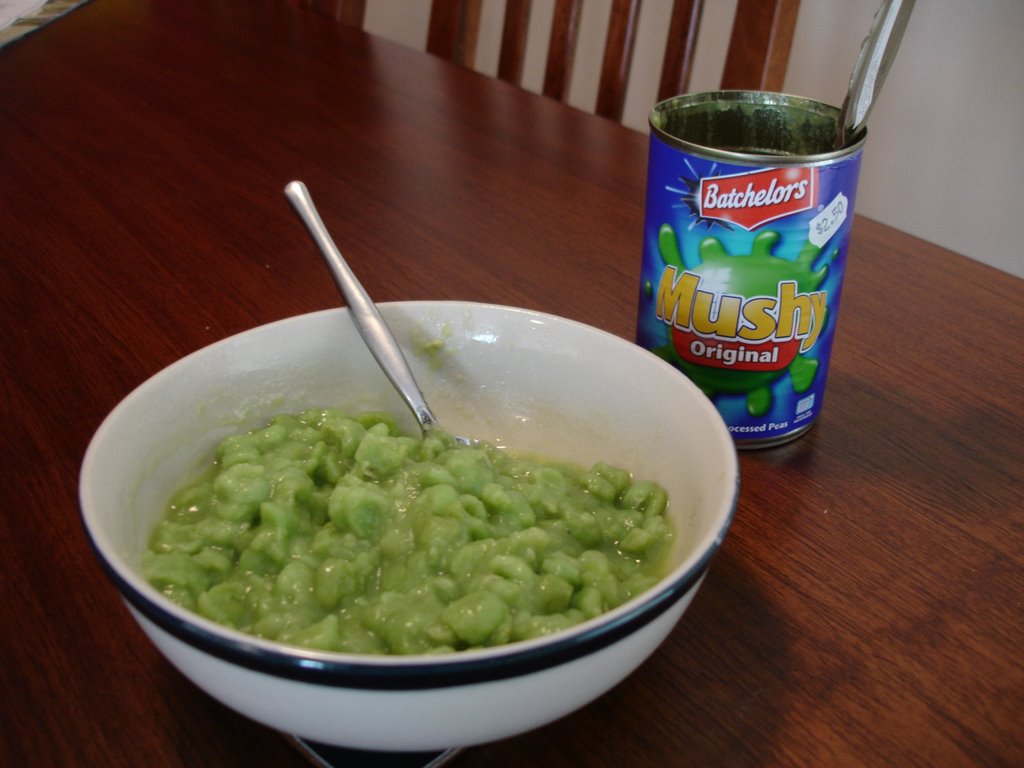
My official review is mixed. It was better than I expected it to be-reminiscent of the condensed Campbell's split pea and bacon soup I loved as a kid-but still a cylindrical mass o' mashed vegetable that tasted just about as good as something like that can. I would only recommend this product to people with a nagging and sick sense of curiosity who also have $2.50 to spare.


Peter immediately started laughing in the grocery store when he saw this and snapped a picture with his cell phone. I just sighed; I had seen this before in other supermarkets. What has the world come to? And just what were these sausages made of if not beef? They had no ingredient label, so my mind just had to wander through all of the worst case scenarios as we walked by the sheep's kidneys toward the kleenex isle. The best thing I can say about these sausages is that they were much cheaper than any of the other items in the meat case. Needless to say we didn't get any.

We also saw this product near the checkout stand. Part of me actually wanted to by a box, just to compare it to the original. I know that they call raisins 'sultanas' here and that it probably tastes exactly like it does in the States, but still. Unfortunately, like most of the imported food here (and a lot of it is imported), it cost way more than I wanted to pay for it. We're in the process of sifting through the markets to find the cheap and healthy locally produced food. It's not proving an easy task, but since when is anything healthy or responsible easy?
I'll end this post with nod to all of you Futurama fans out there. I actually found this product at a dairy (aka convenience store) in Wellington. Not only was is Bachelor's brand food product (conjuring up images of Fry living on specially formulated brown stuff in the year 3000), but it claimed to be the UK's favourite mutilated vegetable matter.
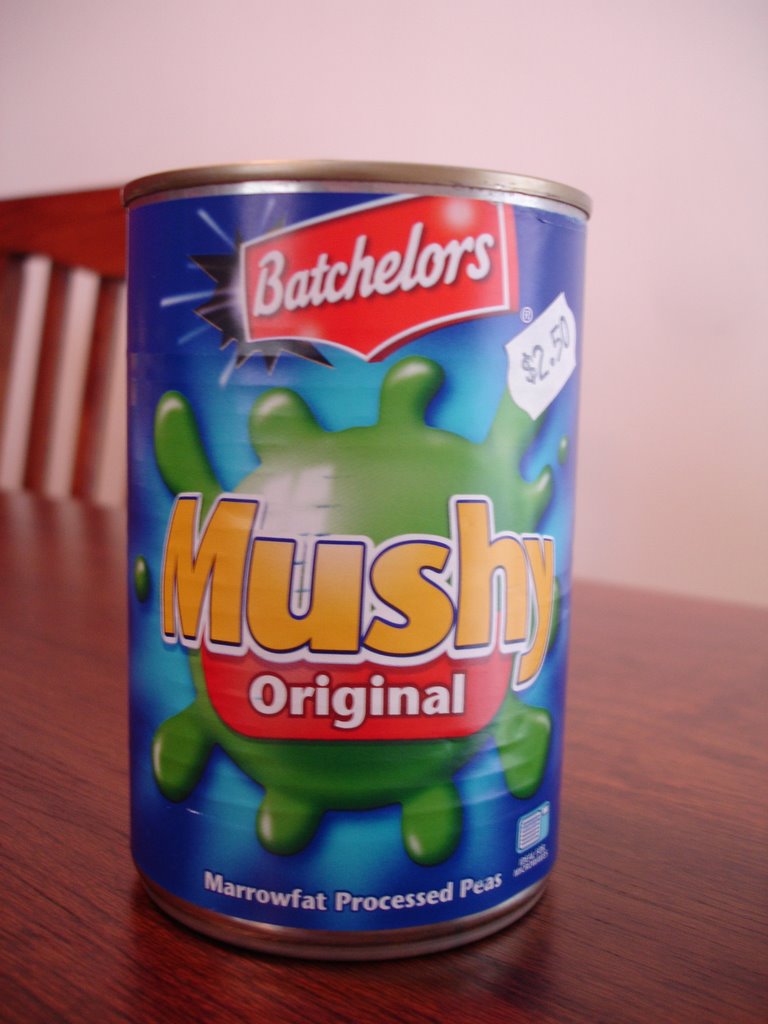
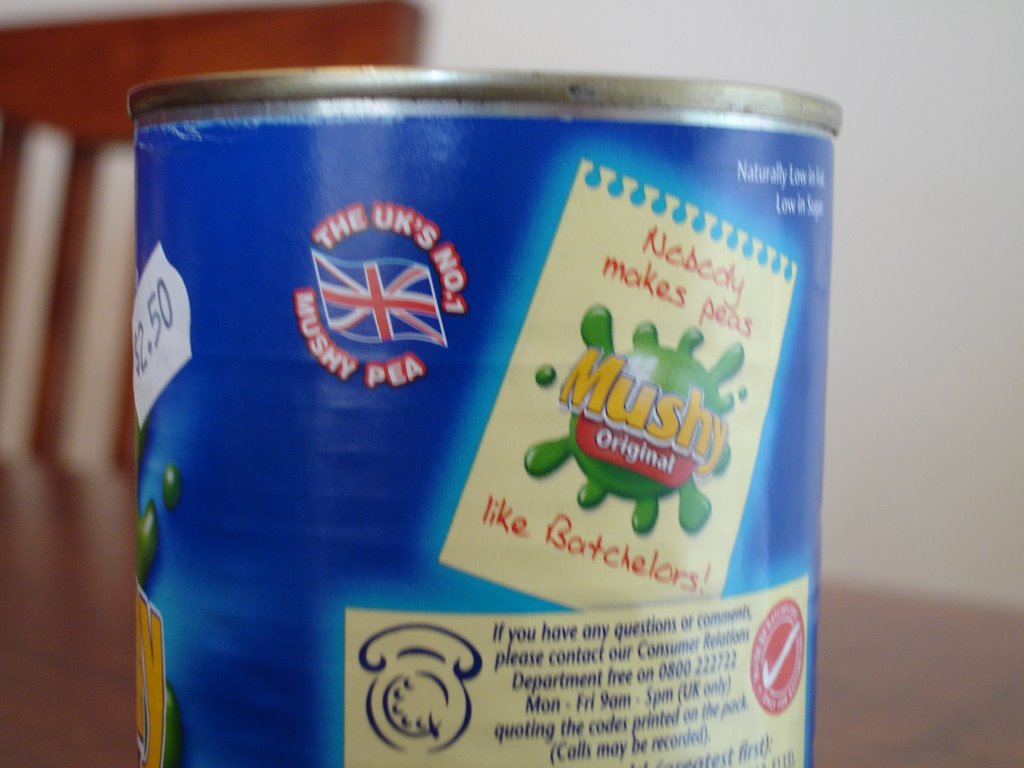
My official review is mixed. It was better than I expected it to be-reminiscent of the condensed Campbell's split pea and bacon soup I loved as a kid-but still a cylindrical mass o' mashed vegetable that tasted just about as good as something like that can. I would only recommend this product to people with a nagging and sick sense of curiosity who also have $2.50 to spare.
Tuesday, December 19, 2006
Greetings from Auckland
So...Auckland.
Big. Sprawling. Culturally diverse. Warmer than Wellington. Rolling waves of suburbia. Surrounded by teal water and walkable-in-your-bare-feet beaches. Home of the Sky Tower and the All Blacks. Also goes by the friendly monicker of "The City of Sails." Population: 1,158,891. Number of cars: roughly 660,000. And now officially the home of Peter and Roni.
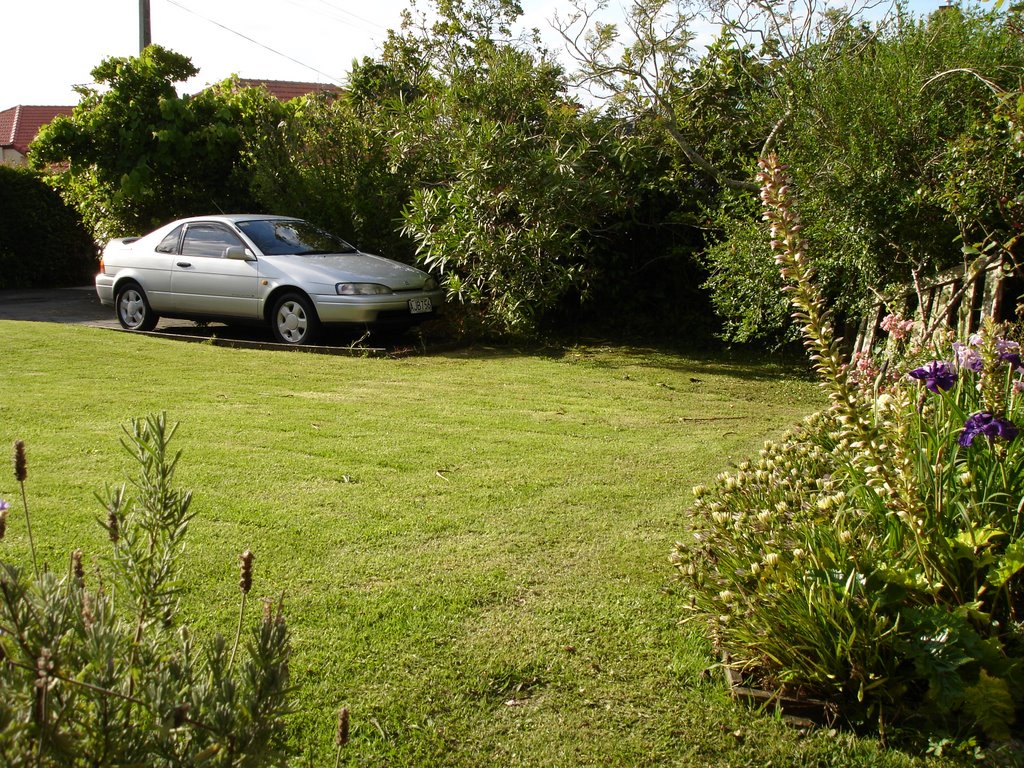
Fact: Aucklanders spend, on average, more money on transportation than food. That'll give you an idea of the car culture around here. Yes, it's as bad as Kiwis say, but I don't think it's any worse than driving during rush hour in any major US city. Needless to say, things are spread out enough that we bought a car on our first full day here. She's small and a bit older, but she's in good shape.
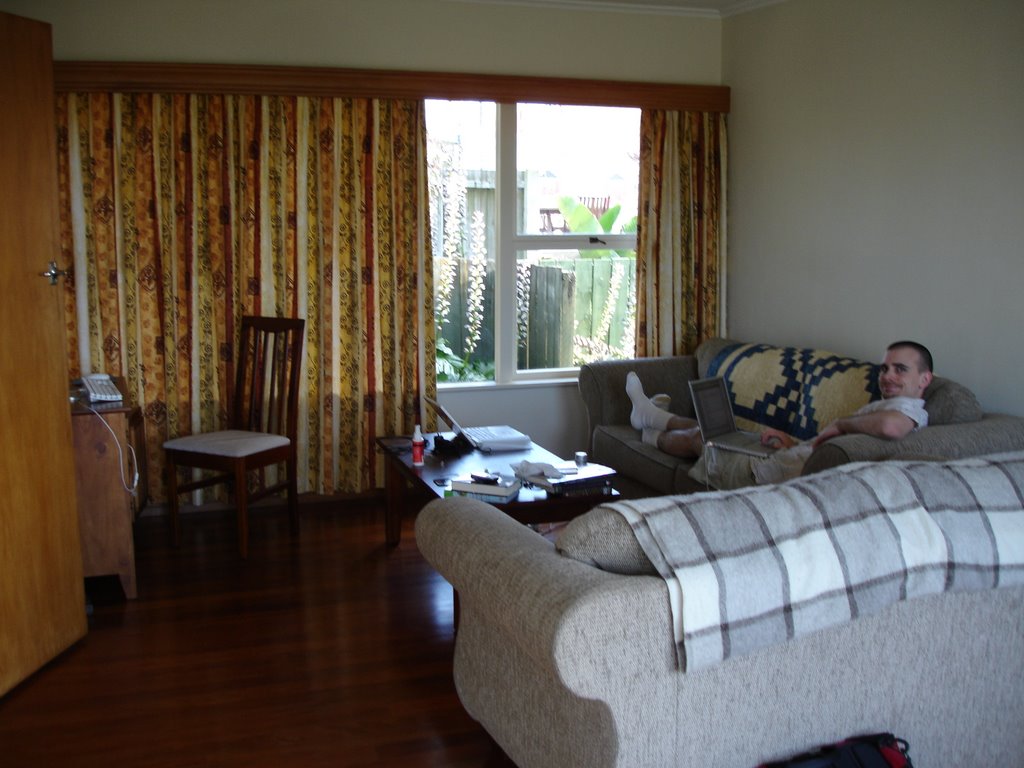
Our furniture and other belongings arrived in good condition a few days after we got to town, and we are now officially mostly unpacked. We still need a few pieces of furniture to really get the place up and running (bookcases and such) but we really like the new place. Let's take a little tour, shall we? A big welcome from Peter...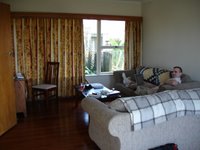


As you can see from the pictures it's nice and sunny, with good Rata wood floors and plenty of trees and flowers to lend shade. I'll get more pictures of the wonderful flowers hanging out around back. It has a shaded yard for barbecuing and friendly neighbours all around of the human, cat, dog and unidentified caged bird varieties. We even have a lemon tree in the back yard. We're told that it will produce lemons if we water it enough, so we're on the ball with that already. I can't wait to be able to say, "Hon, we're out of lemonade. Would you mind popping out to the tree for me?" I doubt it will produce that much, but still, a lemon tree!
We're also about a 15 minute walk from one particularly nice swimming beach. That will definitely come in handy once the weather gets even warmer.
Well great, you might say, Auckland seems pretty nice. You have an apartment you like, you have a month off before you have to go to work, you have swell neighbours. Are there any down sides? Well, as I mentioned earlier, the city lay out is generally sprawling and there is a huge number of cars on the road. Traffic is truly horrendous. The roads here seem to be full to overflowing with single occupant vehicles. And though there are marked bike lanes in a lot of areas, the condition of the roads and paths is such that, as Peter found out today, you can easily take a nasty fall if you don't go pretty darn slow. There are obstacles everywhere, gaping holes in the pavement, rain gutters that run parallel to the roadway and are just big enough to suck your front tire 3 inches down into a sewer drain. In order to get a really good hike or bike ride you basically have to drive someplace. This is far from bad, considering that most of the places we can go to are within a 30-45 min drive, but somehow that seems inconvenient after living in a place like Missoula. To all of you Missoulians (well, Montanans) out there, consider yourselves lucky that nature is literally right at your back door.
Speaking of thing outside back doors, we have something outside ours that we're fairly certain no Montanan has. We have a feral hedgehog. And not the small pet store variety, I'm talking BIG hedgehog. We put some particularly stinky trash out on the back stoop our third night here and later we heard the signature rustling of a garbage snatcher. Having grown up in an area where racoons regularly scatter the contents of a garbage can around an area the size of a baseball diamond within 5 minutes, I ran to the back door with broom in hand. When I opened the door a rather large and un-perturbed looking hedgehog was munching away on our refuse. It kept its nose down and gave me a sidelong glance, as though to get a good, long look at that annoying thing making all the noise. We poked it gently with the broom handle to get it out of our trash, and eventually it waddled away. We almost had the camera out to document the new neighbour but we were too late. Supposedly hedgehogs like to eat dairy products and fruit, so we're going to bait it in order to get a picture of him. Dumpster diver or no, he is a cute little bugger.
Peter thinks we should name him Sonic. I vote for The Hauraki Homebreaker, after the name of the gulf that separates North Shore City from central Auckland. What do you think, gentle reader? The floor is now officially open for all suggestions original and plagiarized. After all, what is a mascot (a status I think he deserves) without a name? A lousy one, that what.
It's evening here and we're closing up for the night. Bugs are much bigger and thicker here, so it's time to close up and snuggle under a comfy quilt with a book (thanks again, Mom, it looks and feels oh so wonderful!). We'll leave you with a picture of the Harbour Bridge and the Sky Tower as seen from the end of our street at dusk. Both are Auckland icons. The trees covered with red blossoms are Pohutukawa trees, commonly called New Zealand Christmas Trees because they bloom in December. They smell wonderful and have red, whisker like petals tipped in yellow pollen. The city is now bathed in pinkish flakes of a New Zealand Christmas.
Big. Sprawling. Culturally diverse. Warmer than Wellington. Rolling waves of suburbia. Surrounded by teal water and walkable-in-your-bare-feet beaches. Home of the Sky Tower and the All Blacks. Also goes by the friendly monicker of "The City of Sails." Population: 1,158,891. Number of cars: roughly 660,000. And now officially the home of Peter and Roni.
Fact: Aucklanders spend, on average, more money on transportation than food. That'll give you an idea of the car culture around here. Yes, it's as bad as Kiwis say, but I don't think it's any worse than driving during rush hour in any major US city. Needless to say, things are spread out enough that we bought a car on our first full day here. She's small and a bit older, but she's in good shape.
Our furniture and other belongings arrived in good condition a few days after we got to town, and we are now officially mostly unpacked. We still need a few pieces of furniture to really get the place up and running (bookcases and such) but we really like the new place. Let's take a little tour, shall we? A big welcome from Peter...
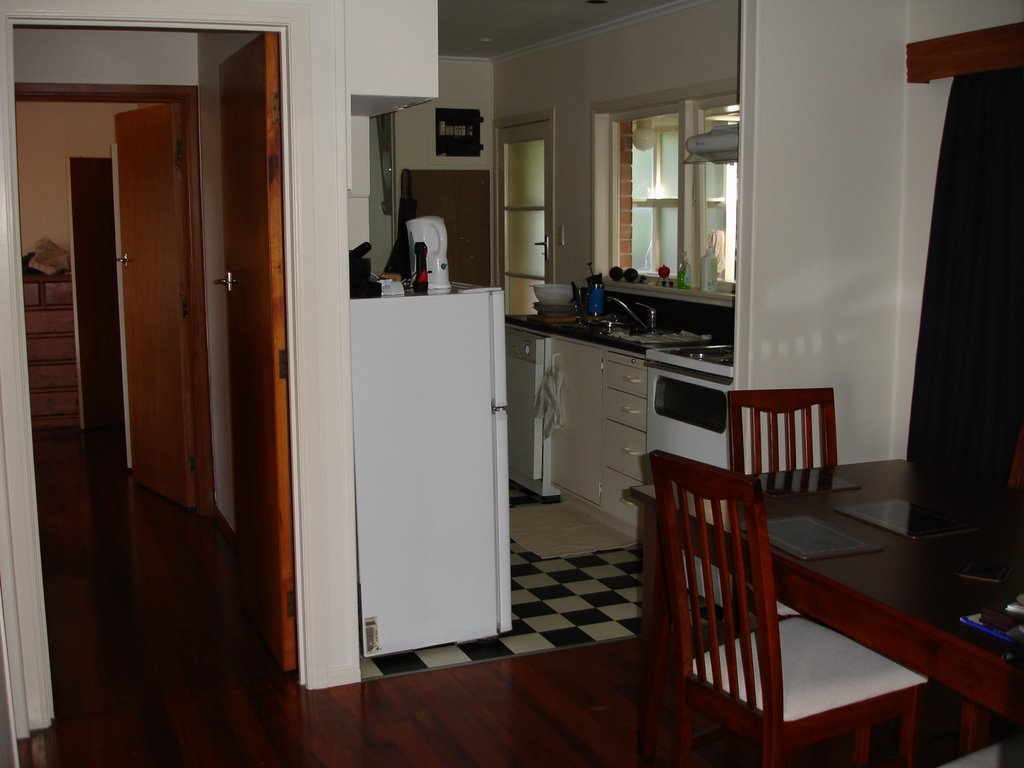

As you can see from the pictures it's nice and sunny, with good Rata wood floors and plenty of trees and flowers to lend shade. I'll get more pictures of the wonderful flowers hanging out around back. It has a shaded yard for barbecuing and friendly neighbours all around of the human, cat, dog and unidentified caged bird varieties. We even have a lemon tree in the back yard. We're told that it will produce lemons if we water it enough, so we're on the ball with that already. I can't wait to be able to say, "Hon, we're out of lemonade. Would you mind popping out to the tree for me?" I doubt it will produce that much, but still, a lemon tree!
We're also about a 15 minute walk from one particularly nice swimming beach. That will definitely come in handy once the weather gets even warmer.
Well great, you might say, Auckland seems pretty nice. You have an apartment you like, you have a month off before you have to go to work, you have swell neighbours. Are there any down sides? Well, as I mentioned earlier, the city lay out is generally sprawling and there is a huge number of cars on the road. Traffic is truly horrendous. The roads here seem to be full to overflowing with single occupant vehicles. And though there are marked bike lanes in a lot of areas, the condition of the roads and paths is such that, as Peter found out today, you can easily take a nasty fall if you don't go pretty darn slow. There are obstacles everywhere, gaping holes in the pavement, rain gutters that run parallel to the roadway and are just big enough to suck your front tire 3 inches down into a sewer drain. In order to get a really good hike or bike ride you basically have to drive someplace. This is far from bad, considering that most of the places we can go to are within a 30-45 min drive, but somehow that seems inconvenient after living in a place like Missoula. To all of you Missoulians (well, Montanans) out there, consider yourselves lucky that nature is literally right at your back door.
Speaking of thing outside back doors, we have something outside ours that we're fairly certain no Montanan has. We have a feral hedgehog. And not the small pet store variety, I'm talking BIG hedgehog. We put some particularly stinky trash out on the back stoop our third night here and later we heard the signature rustling of a garbage snatcher. Having grown up in an area where racoons regularly scatter the contents of a garbage can around an area the size of a baseball diamond within 5 minutes, I ran to the back door with broom in hand. When I opened the door a rather large and un-perturbed looking hedgehog was munching away on our refuse. It kept its nose down and gave me a sidelong glance, as though to get a good, long look at that annoying thing making all the noise. We poked it gently with the broom handle to get it out of our trash, and eventually it waddled away. We almost had the camera out to document the new neighbour but we were too late. Supposedly hedgehogs like to eat dairy products and fruit, so we're going to bait it in order to get a picture of him. Dumpster diver or no, he is a cute little bugger.
Peter thinks we should name him Sonic. I vote for The Hauraki Homebreaker, after the name of the gulf that separates North Shore City from central Auckland. What do you think, gentle reader? The floor is now officially open for all suggestions original and plagiarized. After all, what is a mascot (a status I think he deserves) without a name? A lousy one, that what.
It's evening here and we're closing up for the night. Bugs are much bigger and thicker here, so it's time to close up and snuggle under a comfy quilt with a book (thanks again, Mom, it looks and feels oh so wonderful!). We'll leave you with a picture of the Harbour Bridge and the Sky Tower as seen from the end of our street at dusk. Both are Auckland icons. The trees covered with red blossoms are Pohutukawa trees, commonly called New Zealand Christmas Trees because they bloom in December. They smell wonderful and have red, whisker like petals tipped in yellow pollen. The city is now bathed in pinkish flakes of a New Zealand Christmas.


Monday, October 30, 2006
Happy Halloween!
On a lighter note than the last post...Happy Halloween! I have to admit, I miss the general revelry a bit more than I thought I would. Even though we didn't do anything more last year than carve jack-o'-lanterns and buy candy that no one came for because is was too cold, at least we got to see kids get excited about institutionalised make-believe. I like the fact that in America that kind of imaginative revelry is possible and even encouraged for one night of the year, even if my adult life doesn't always make the time for it.
Halloween isn't celebrated nearly as much here as it is in the States, but I get the feeling that it's starting to catch on. There are a few stores that have advertised costumes and candy, and there are a few stoops in the neighbourhood with carved pumpkins on them (not the big orange kind but the smaller peach-coloured kind you get for cooking). I've even seen a few clubs downtown advertising parties, but they're pretty few and far between. All in all there's a distinct lack of orange here. I did see a black cat today, so I'm actually taking that as a good sign.
There's another holiday later this week that may be overshadowing this new-fangled Halloween stuff. It's called Guy Fawkes Day and it's causing all kinds of fire-cracker fun. Basically, this Fawkes fellow tried to blow up King James I and the rest of the House of Parliament in Britain. The original plan was to light off 32 barrels of gunpowder stashed in the basement of the House of Lords on 5 November 1605. This came to be known as the Gunpowder Plot of 1605, and was a planned act of violence by an angry group of Catholics against a Protestant government that didn't exactly have a good track record of treating Catholics with respect. Needless to say old Guy was caught on 5 November, tortured and summarily executed. Some argue that he was tipped off by a member of his group who feared for the lives of innocent civilians, but no one knows for sure. What we do know is that 5 November, or Guy Fawkes Day, is now either celebrated as the day a traitor was struck down or the anniversary of an attempt to do away with intolerant government. I suppose how you celebrate the day depends on your political persuasion. You can find out more about this interesting holiday at www.gunpowder-plot.org.
So far I get the impression that the holiday, in it's modern form in New Zealand, is an excuse to buy fireworks legally and blow them up at all hours of the day and night. Officials keep warning that if the sparkler bombs and random acts of arson don't stop they'll ban the sale of fireworks to private citizens. We'll have to see what comes of it when the holiday passes, but from the crime stats in the daily news it's not looking good for the Kiwi pyros out there. The holiday used to be celebrated with bonfires (the holiday is also known as Bonfire Day) and the burning of Guy Fawkes in effigy. The effigy-burning isn't as common anymore, but playing with fire is still the way to do it up right here. We're planning on getting our fix of explosives at a professional fireworks show over the harbour this weekend. Should be sweet as!
Halloween isn't celebrated nearly as much here as it is in the States, but I get the feeling that it's starting to catch on. There are a few stores that have advertised costumes and candy, and there are a few stoops in the neighbourhood with carved pumpkins on them (not the big orange kind but the smaller peach-coloured kind you get for cooking). I've even seen a few clubs downtown advertising parties, but they're pretty few and far between. All in all there's a distinct lack of orange here. I did see a black cat today, so I'm actually taking that as a good sign.
There's another holiday later this week that may be overshadowing this new-fangled Halloween stuff. It's called Guy Fawkes Day and it's causing all kinds of fire-cracker fun. Basically, this Fawkes fellow tried to blow up King James I and the rest of the House of Parliament in Britain. The original plan was to light off 32 barrels of gunpowder stashed in the basement of the House of Lords on 5 November 1605. This came to be known as the Gunpowder Plot of 1605, and was a planned act of violence by an angry group of Catholics against a Protestant government that didn't exactly have a good track record of treating Catholics with respect. Needless to say old Guy was caught on 5 November, tortured and summarily executed. Some argue that he was tipped off by a member of his group who feared for the lives of innocent civilians, but no one knows for sure. What we do know is that 5 November, or Guy Fawkes Day, is now either celebrated as the day a traitor was struck down or the anniversary of an attempt to do away with intolerant government. I suppose how you celebrate the day depends on your political persuasion. You can find out more about this interesting holiday at www.gunpowder-plot.org.
So far I get the impression that the holiday, in it's modern form in New Zealand, is an excuse to buy fireworks legally and blow them up at all hours of the day and night. Officials keep warning that if the sparkler bombs and random acts of arson don't stop they'll ban the sale of fireworks to private citizens. We'll have to see what comes of it when the holiday passes, but from the crime stats in the daily news it's not looking good for the Kiwi pyros out there. The holiday used to be celebrated with bonfires (the holiday is also known as Bonfire Day) and the burning of Guy Fawkes in effigy. The effigy-burning isn't as common anymore, but playing with fire is still the way to do it up right here. We're planning on getting our fix of explosives at a professional fireworks show over the harbour this weekend. Should be sweet as!
Monday, September 11, 2006
The Interesting Thing About Public Transit
Since arriving in Wellington, public transit has been my lifeline to work. We live on the opposite side of a 'mountain'- read 'hill' if you're from Montana-from the rest of the city, and the only way through when wearing professional attire is via bus. Most mornings, this takes me to the train station where I board a car for destinations on the northern end of the harbour. While it takes a little longer to get around than by car, I somehow don't feel like such a nameless face when I'm on a platform with many other nameless faces. A teacher at an area school made the point that commuting alone creates a sense of separateness, and even conditions us to pull away from people we don't know. I have to say that this is a fairly accurate and astute observation.
While I haven't made any friends per se on a train or bus, I've definitely met a number of characters that have become familiar faces. There's the ticket taker on a frequently taken train of mine who is there every morning, without fail, with a hearty "good morning, how are you today" and a smile (from under a huge red mustache). A small thing, yes, but a nice way to start the day. Then there are the two 20-something guys who always sit near each other, each reading parts of the same paper, buy each other coffees and get off the train together, but never speak a word to each other while actually ON the train. My favourite, though, is the young angry bus driver who works the afternoon shift in Porirua. He's not in the least self-conscious about flipping off fellow motorists, and he'll mutter the most foul obscenities under his breath when the middle school kids press the call button and then don't get off the bus. I always smile and thank him when I get off, and he always says "cheers" with a smile in return.
Even on the street at crosswalks and bus stops people will strike up small conversations with you about whatever happens to be going on. I've encountered this congeniality since the first day we got here, but this willingness to interact has never hit me as strongly as it did at the train station earlier this week.
I was at a coffee cart early one morning waiting for my cuppa. The woman in front of me had placed a rather large order and was frantically counting out coins to pay for it all. To our left sat a train waiting to pull away, and I noticed a conductor waving her arms in the direction of the coffee cart. I thought nothing of it, seeing as it wasn't my train (or it could have been that early morning I-really-need-some-coffee haze clouding my mind). A minute later another conductor came up to this woman in front of me and asked her if this nearest train was hers. When she said yes he told her that it was leaving right then. Her face froze, and you could tell that she was stuck having to choose between dashing for her train empty handed, or asking the barista to give her her money back. Instead of heading back for the train or telling the woman to hustle it up, the conductor took one look at her conflicted expression and politely asked the barista how long it would be until her drinks were done. The cart employees were just about done, so the conductor waited with this woman and even helped her carry her drinks back to the train. Another conductor was waiting nearby to pleasantly shoo them onto a car. The minute the car doors closed, the train took off.
I had to pause at this, dumbfounded by what I had just seen. The first thought through my mind was "well, that never would have happened in Germany". Then I thought, "wait a minute, where would that have happened other than here"? I had just witnessed a quintessentially kiwi encounter. It's this willingness to interact that makes New Zealand unique, a sort of every-day-diplomacy that keeps everyone moving along congenially. Things are rarely black and white, and from my perspective it seems like Kiwis grow up knowing that if you just talk about an issue a little bit all parties can usually get what they need. No need to fuss, shout or throw down ultimatums. One has no reason to pull away from others here; to do so would actually do more damage.
It's nice to know that kindness can happen at 7:15 am before you have your coffee.
While I haven't made any friends per se on a train or bus, I've definitely met a number of characters that have become familiar faces. There's the ticket taker on a frequently taken train of mine who is there every morning, without fail, with a hearty "good morning, how are you today" and a smile (from under a huge red mustache). A small thing, yes, but a nice way to start the day. Then there are the two 20-something guys who always sit near each other, each reading parts of the same paper, buy each other coffees and get off the train together, but never speak a word to each other while actually ON the train. My favourite, though, is the young angry bus driver who works the afternoon shift in Porirua. He's not in the least self-conscious about flipping off fellow motorists, and he'll mutter the most foul obscenities under his breath when the middle school kids press the call button and then don't get off the bus. I always smile and thank him when I get off, and he always says "cheers" with a smile in return.
Even on the street at crosswalks and bus stops people will strike up small conversations with you about whatever happens to be going on. I've encountered this congeniality since the first day we got here, but this willingness to interact has never hit me as strongly as it did at the train station earlier this week.
I was at a coffee cart early one morning waiting for my cuppa. The woman in front of me had placed a rather large order and was frantically counting out coins to pay for it all. To our left sat a train waiting to pull away, and I noticed a conductor waving her arms in the direction of the coffee cart. I thought nothing of it, seeing as it wasn't my train (or it could have been that early morning I-really-need-some-coffee haze clouding my mind). A minute later another conductor came up to this woman in front of me and asked her if this nearest train was hers. When she said yes he told her that it was leaving right then. Her face froze, and you could tell that she was stuck having to choose between dashing for her train empty handed, or asking the barista to give her her money back. Instead of heading back for the train or telling the woman to hustle it up, the conductor took one look at her conflicted expression and politely asked the barista how long it would be until her drinks were done. The cart employees were just about done, so the conductor waited with this woman and even helped her carry her drinks back to the train. Another conductor was waiting nearby to pleasantly shoo them onto a car. The minute the car doors closed, the train took off.
I had to pause at this, dumbfounded by what I had just seen. The first thought through my mind was "well, that never would have happened in Germany". Then I thought, "wait a minute, where would that have happened other than here"? I had just witnessed a quintessentially kiwi encounter. It's this willingness to interact that makes New Zealand unique, a sort of every-day-diplomacy that keeps everyone moving along congenially. Things are rarely black and white, and from my perspective it seems like Kiwis grow up knowing that if you just talk about an issue a little bit all parties can usually get what they need. No need to fuss, shout or throw down ultimatums. One has no reason to pull away from others here; to do so would actually do more damage.
It's nice to know that kindness can happen at 7:15 am before you have your coffee.
Saturday, August 19, 2006
Have you eaten your wallaby today?
When I came down here, I was expecting to get to eat some different foods. But not wallaby. I figured that 1. those cute little critters only lived in Australia and 2. they weren't a food commodity. And thanks to travel, my assumptions have been proved wrong yet again. There are a few of the little buggers on parts of the south island (transplanted there by humans), and they are obviously making their way into the food chain somehow. I don't know if they're farmed, or if they're hunted (much like possum is hunted because of it's ivasive and destructive nature).
This edible adventure happened a few weeks ago when Peter and I went out for pizza. We saw a special on the board for a wallaby pizza with nuts and orange relish. Thinking it couldn't taste that bad, we went for it. And we were right; wallabies are as tasty as they are cute. They taste like a good beef shank, and the orange relish made it wonderful sweet-savoury dish.
Watch out, wallabies, you're now on our culinary hit list.

This edible adventure happened a few weeks ago when Peter and I went out for pizza. We saw a special on the board for a wallaby pizza with nuts and orange relish. Thinking it couldn't taste that bad, we went for it. And we were right; wallabies are as tasty as they are cute. They taste like a good beef shank, and the orange relish made it wonderful sweet-savoury dish.
Watch out, wallabies, you're now on our culinary hit list.

Thursday, July 20, 2006
Wintry Goings-On
Little more than a month ago, we were living in what seemed like limbo. No jobs, no permanent address, no mental energy to really take time to enjoy sightseeing (the worry that comes along with a job search is uniquely plaguing). Then, just like those warm and sunny winter days here, some goodness come out of nowhere all at once and without warning.
Within the course of about a week and a half, both Peter and I landed jobs and we found a decent apartment. Just like that. And we've been at a sprint ever since.
Peter's job is with the Ministry of Agriculture and Forestry in a security architecture capacity. And I found a relief (substitute) teaching pool that arranges work for relief teachers at all of the various schools in the Wellington area. There are so many of them that these pools are a pretty common and handy way for us relievers to get and maintain contacts.
Since I still had to wait for a bit of paperwork to get processed before I could start working, I took on the temporary job of getting our apartment into shape. You don't quite realise how much crap you have--and need, really--until you either move it, store it, sell it, or replace it all. In our case, until you have to sell it all then replace it. Oy.
Since we don't have a car, I've been making plenty of trips in to town on the bus and getting as much as I can carry back without knocking elderly women out of their seats. It probably would have been a lot easier had we a car, but then again it would have been a lot easier to spend more than was necessary had we a car to carry a bunch of crap in. At least this way we're more aware of the necessities and not tempted to get too many fun things. Although it has been pretty fun to outfit our kitchen with decent cookware and our living room with matching furniture. We even have room for a dining room table (as if the quasi-British accent didn't make us Yanks feel civilised enough).
So here we live, in our own flat not far from our last place in the Hataitai suburb, with work to occupy our days and errands to occupy our evenings and weekends. We're into a new routine, and, although it's keeping us busy, life is good.
Peter's work is interesting, as is mine, and we're starting to get a sense for what it's like to really live in New Zealand. You learn quite a bit about a culture from dealing with people on a professional level. We've learned that the morning tea ritual, a break at mid morning where people relax with a snack, is pretty common at work as well as for tourists. We've also learned that it's not uncommon for work places to go out on a Friday after work to have a staff drink at the pub. Social time seems to be pretty important here.
I'm also getting to learn a lot about the culture from the kids I meet in the schools. Children are culture sponges, and everything they do has been taught to them by through their parents, the movies they watch, and the values placed on them by society. They're turning out to be a curious mixture of Kiwi and American culture, and it's pretty apparent that all of the American media, music, and marketing that makes its way here has had a big impact. I've been told to keep an eye out for American spellings in English classroom here, as most kids type their projects in Microsoft Word, which has a default spell checker set to American spellings. Odd, eh? I guess that's one more incentive for me to quickly learn to spell, punctuate, and conjugate within the language system here. We've even met some Kiwis who actually know more about American history from watching shows like Deadwood than some Americans do after having gone through US schools. You have to hand it to the Kiwis; they're a pretty culturally savvy lot.
We'll be posting again soon about some of the fun things we've done and seen when the sun comes out here. The sun isn't a common visitor for us at the moment, but when she comes out the whole of Wellington scrambles outside. Unfortunately, the work-a-day world is just as boring here as it is in the states, so not much to record there as far as photos are concerned. Stay tuned, we'll be posting again soon!
Within the course of about a week and a half, both Peter and I landed jobs and we found a decent apartment. Just like that. And we've been at a sprint ever since.
Peter's job is with the Ministry of Agriculture and Forestry in a security architecture capacity. And I found a relief (substitute) teaching pool that arranges work for relief teachers at all of the various schools in the Wellington area. There are so many of them that these pools are a pretty common and handy way for us relievers to get and maintain contacts.
Since I still had to wait for a bit of paperwork to get processed before I could start working, I took on the temporary job of getting our apartment into shape. You don't quite realise how much crap you have--and need, really--until you either move it, store it, sell it, or replace it all. In our case, until you have to sell it all then replace it. Oy.
Since we don't have a car, I've been making plenty of trips in to town on the bus and getting as much as I can carry back without knocking elderly women out of their seats. It probably would have been a lot easier had we a car, but then again it would have been a lot easier to spend more than was necessary had we a car to carry a bunch of crap in. At least this way we're more aware of the necessities and not tempted to get too many fun things. Although it has been pretty fun to outfit our kitchen with decent cookware and our living room with matching furniture. We even have room for a dining room table (as if the quasi-British accent didn't make us Yanks feel civilised enough).
So here we live, in our own flat not far from our last place in the Hataitai suburb, with work to occupy our days and errands to occupy our evenings and weekends. We're into a new routine, and, although it's keeping us busy, life is good.
Peter's work is interesting, as is mine, and we're starting to get a sense for what it's like to really live in New Zealand. You learn quite a bit about a culture from dealing with people on a professional level. We've learned that the morning tea ritual, a break at mid morning where people relax with a snack, is pretty common at work as well as for tourists. We've also learned that it's not uncommon for work places to go out on a Friday after work to have a staff drink at the pub. Social time seems to be pretty important here.
I'm also getting to learn a lot about the culture from the kids I meet in the schools. Children are culture sponges, and everything they do has been taught to them by through their parents, the movies they watch, and the values placed on them by society. They're turning out to be a curious mixture of Kiwi and American culture, and it's pretty apparent that all of the American media, music, and marketing that makes its way here has had a big impact. I've been told to keep an eye out for American spellings in English classroom here, as most kids type their projects in Microsoft Word, which has a default spell checker set to American spellings. Odd, eh? I guess that's one more incentive for me to quickly learn to spell, punctuate, and conjugate within the language system here. We've even met some Kiwis who actually know more about American history from watching shows like Deadwood than some Americans do after having gone through US schools. You have to hand it to the Kiwis; they're a pretty culturally savvy lot.
We'll be posting again soon about some of the fun things we've done and seen when the sun comes out here. The sun isn't a common visitor for us at the moment, but when she comes out the whole of Wellington scrambles outside. Unfortunately, the work-a-day world is just as boring here as it is in the states, so not much to record there as far as photos are concerned. Stay tuned, we'll be posting again soon!
Sunday, June 04, 2006
Happy Queen's Birthday!
Today New Zealand celebrates Queen Elizabeth II's birthday. Her birthday is actually 21 April, but New Zealand celebrates on the first Monday of June. The country enjoys a three day weekend, and there are a few ceremonies held here and there (though there was nothing special going on here in Wellington).
The nation-wide excitement that happens on the Queen's Birthday is the Queen's Birthday Honours list. This is a list that the Queen comes out with to acknowledge those New Zealand citizens who contribute to New Zealand's culture and society. You can see some of the recipients here: http://www.nzherald.co.nz/feature/story.cfm?c_id=513&objectid=10385054
As far as I can tell, most people use the weekend a lot like Americans use the President's Day weekend: make home improvements, take skiing trips, visit family, go shopping, etc. One of the main differences is that here, any business that chooses to stay open on a public holiday like this has to pay their employees holiday pay. This means that restaurants will tack a 15% surcharge to your meal (a very fair thing to do, I must say), and some stores and shops choose to close in order to avoid the added operational costs. So it's a crap shoot as to what's open and what isn't. We spent the day in classic kiwi style: we went shopping for furniture for the new apartment and went out for lunch. After all, it's our new patriotic duty. :)
The nation-wide excitement that happens on the Queen's Birthday is the Queen's Birthday Honours list. This is a list that the Queen comes out with to acknowledge those New Zealand citizens who contribute to New Zealand's culture and society. You can see some of the recipients here: http://www.nzherald.co.nz/feature/story.cfm?c_id=513&objectid=10385054
As far as I can tell, most people use the weekend a lot like Americans use the President's Day weekend: make home improvements, take skiing trips, visit family, go shopping, etc. One of the main differences is that here, any business that chooses to stay open on a public holiday like this has to pay their employees holiday pay. This means that restaurants will tack a 15% surcharge to your meal (a very fair thing to do, I must say), and some stores and shops choose to close in order to avoid the added operational costs. So it's a crap shoot as to what's open and what isn't. We spent the day in classic kiwi style: we went shopping for furniture for the new apartment and went out for lunch. After all, it's our new patriotic duty. :)
Tuesday, May 30, 2006
The Weather Gods Must Be Crazy
Old Man Winter is the same bastard wherever you go. He has this knack for finding your comfort zone and then, with the fingertips of one hand lightly touching those on the other and a maniacal gleam in his eye, nudging the temperature and wind speed just beyond it. I normally consider myself tough when it comes to weather; anyone from Montana has to to avoid the mockery. But I feel that, because I grew up in Montana, I'm also tough enough to take the humiliation standing tall.
I, a country girl, am hiding from 45 degree weather.
It was bound to happen at some time. Like all Montanans who leave their native habitat, I knew that my body would go into shock from the warmth and humidity, unable to cope with hospitable conditions. I knew that eventually my blood would thin, I would gradually switch from wearing long sleeved T-shirts to wool sweaters, and that I would take to using an umbrella instead of just nestling into an ever-dampening jacket collar.
Perhaps it's because I had this image of New Zealand as a tropical paradise. I came here looking for lush, warm, sun drenched valleys safely hidden from the snowy mountains by a wall of silver ferns. Research told me that it can get quite cold in most of the country during the winter, but because I just left a Montana winter behind, my desires overshadowed common sense. I feel a lot like the Montanan in spring who pulls out the shorts just a few weeks too early; I'm stubbornly (and unsuccessfully) trying to force the weather to accommodate my pasty-fleshed desires. I think I'm going to put away the tank tops and go shopping for a few of those comfy looking New Zealand wool cardigans.
That being said, we've been getting a healthy amount sunshine. When those days roll around we hop on the bus and head out for a walk in a new-to-us part of town. We've mostly been exploring the suburbs, as we've been apartment hunting, but on occasion we venture into the more natural parts of the city.
 Not too long ago we heard that a seal colony comes to shore every winter near Island Bay, a southern suburb of Wellington. Deciding that while it was breezy and grey, it wasn't all that cold. So off we went to find some seals. Island Bay is named after it's main island feature, Tapu Te Ranga, which served as a refuge for the Ngati Ira Maori tribe when they were under attack. It protects the bay from the harsh Cook Straight weather, and is rather nice to look at, too. The shoreline in this area is fairly rocky, and the tide pools collect surprisingly little plant life. Here's one of the more occupied pools we found.
 While we didn't see any seals or blue penguins (who also come to shore here), we did get to watch a number of birds playing in the updrafts generated near the cliffs. With the weather getting colder by the minute, we headed back to our flat for the day. These sunny periods just don't last long enough for me.
I, a country girl, am hiding from 45 degree weather.
It was bound to happen at some time. Like all Montanans who leave their native habitat, I knew that my body would go into shock from the warmth and humidity, unable to cope with hospitable conditions. I knew that eventually my blood would thin, I would gradually switch from wearing long sleeved T-shirts to wool sweaters, and that I would take to using an umbrella instead of just nestling into an ever-dampening jacket collar.
Perhaps it's because I had this image of New Zealand as a tropical paradise. I came here looking for lush, warm, sun drenched valleys safely hidden from the snowy mountains by a wall of silver ferns. Research told me that it can get quite cold in most of the country during the winter, but because I just left a Montana winter behind, my desires overshadowed common sense. I feel a lot like the Montanan in spring who pulls out the shorts just a few weeks too early; I'm stubbornly (and unsuccessfully) trying to force the weather to accommodate my pasty-fleshed desires. I think I'm going to put away the tank tops and go shopping for a few of those comfy looking New Zealand wool cardigans.
That being said, we've been getting a healthy amount sunshine. When those days roll around we hop on the bus and head out for a walk in a new-to-us part of town. We've mostly been exploring the suburbs, as we've been apartment hunting, but on occasion we venture into the more natural parts of the city.
 Not too long ago we heard that a seal colony comes to shore every winter near Island Bay, a southern suburb of Wellington. Deciding that while it was breezy and grey, it wasn't all that cold. So off we went to find some seals. Island Bay is named after it's main island feature, Tapu Te Ranga, which served as a refuge for the Ngati Ira Maori tribe when they were under attack. It protects the bay from the harsh Cook Straight weather, and is rather nice to look at, too. The shoreline in this area is fairly rocky, and the tide pools collect surprisingly little plant life. Here's one of the more occupied pools we found.
 While we didn't see any seals or blue penguins (who also come to shore here), we did get to watch a number of birds playing in the updrafts generated near the cliffs. With the weather getting colder by the minute, we headed back to our flat for the day. These sunny periods just don't last long enough for me.
Wednesday, May 17, 2006
Mr. Rodgers, Eat Your Heart Out
This morning turned out to be exactly the opposite of what we planned.
We had set the alarm for 'early', 6 a.m., so we could get out for an early breakfast and get some work done at cafe with broadband access. So what do we do when our alarm diligently reminds us of our ambition? Like red-blooded Americans, we turned off the alarm and slept for another two hours. So much for self-guided ambition.
But, determination has a handy way of turning into simmering coals of guilt, and we decided not to write the day off. It was sunny, a first in at least three days, and looked like a great day to explore the city. On our way out we stopped at our newest coffee hangout here in Hataitai, Salvation Coffee, for a bite. We started chatting with the owner, and he was able to offer us some insight on the rental situation in this neighbourhood. A couple at the next table had some more information on the rental market, and before we knew it we had been chatting for nearly two hours.
These types of incidents aren't uncommon here. We're finding that people are ready to lend a hand if they feel it will be helpful, and typically introduce themselves to strangers more than is normal in America. As in the case of this morning, we've been able to get some good info on how things work here. The people we met today were able to give us some great insight on the rental market, tips as to where to find good cycles, and they offered us a different perspective on the war in Iraq. I was even able to make a professional contact by the end of the conversation (one of the chaps we talked to has a friend who teaches high school English and offered to pass my contact info along to her).
Not exactly how we planned to spend our morning, but it wasn't exactly bad way to spend the morning, either.
I guess the moral of the story would be this: don't be afraid to offer what you can to those who look like they could use it. While we've all grown up with the advice "don't talk to strangers" ringing in our ears, perhaps closing off those lines of communication is what keeps us from becoming anything other than strangers. I've come to the conclusion that this shrinking global community of ours needs bigger neighbourhoods.
We had set the alarm for 'early', 6 a.m., so we could get out for an early breakfast and get some work done at cafe with broadband access. So what do we do when our alarm diligently reminds us of our ambition? Like red-blooded Americans, we turned off the alarm and slept for another two hours. So much for self-guided ambition.
But, determination has a handy way of turning into simmering coals of guilt, and we decided not to write the day off. It was sunny, a first in at least three days, and looked like a great day to explore the city. On our way out we stopped at our newest coffee hangout here in Hataitai, Salvation Coffee, for a bite. We started chatting with the owner, and he was able to offer us some insight on the rental situation in this neighbourhood. A couple at the next table had some more information on the rental market, and before we knew it we had been chatting for nearly two hours.
These types of incidents aren't uncommon here. We're finding that people are ready to lend a hand if they feel it will be helpful, and typically introduce themselves to strangers more than is normal in America. As in the case of this morning, we've been able to get some good info on how things work here. The people we met today were able to give us some great insight on the rental market, tips as to where to find good cycles, and they offered us a different perspective on the war in Iraq. I was even able to make a professional contact by the end of the conversation (one of the chaps we talked to has a friend who teaches high school English and offered to pass my contact info along to her).
Not exactly how we planned to spend our morning, but it wasn't exactly bad way to spend the morning, either.
I guess the moral of the story would be this: don't be afraid to offer what you can to those who look like they could use it. While we've all grown up with the advice "don't talk to strangers" ringing in our ears, perhaps closing off those lines of communication is what keeps us from becoming anything other than strangers. I've come to the conclusion that this shrinking global community of ours needs bigger neighbourhoods.
Wednesday, May 10, 2006
Trying on a New Routine For Size. Mmmm...Roomy.
Truth in Life #1: Adventure is the spice of life.
Roni's Truth in Life #2: Living out of a suitcase stinks.
So how to reconcile the two? Funky dresser shopping! We'll need an apartment to keep said dresser in, though, and that means choosing a neighbourhood, which will in turn depend on where we find work.
Sigh...I suppose this logic dictates we finally let go of the vacation portion of our trip and get down to business. So we've been filling out applications, getting details squared away, and going to job interviews this week. While no one really wants to let go of that sweet goddess called holiday, work and a routine puts vacation time in perspective.
Having a routine has helped us immensely in our reluctant retreat back to normal life. We've taken inspiration from our moms and set a bed time and rising time for ourselves. We're also cooking meals in our flat quite a bit, although popping down the street for a little taste of Hell is always a temptation. (For those of you unfamiliar with NZ's culinary scene, Hell is a pizza chain that has all kinds of sinfully delicious pies. In this picture we're enjoying a taste of Wrath.) Funny, it isn't as hot there as I've been led to believe...must be the humidity down here.
 During the day we get down to business, and we reserve the evenings for relaxation. We're even developing a social circle through the Aikido class we're taking three days a week. This has been the best lifestyle choice we've made here so far. This dojo practices the same style of Aikido that I trained in in the Missoula, with the expected stylistic differences of the sensei, of course. My body's felt right at home on the mat so far, and the people we train with are such a friendly and energetic lot that we feel very welcome. I'm quickly understanding the comforts of physical exercise (read: getting thrown around).
 Here's a picture of Hataitai, the neighbourhood we're staying in. We're able to see Evans Bay, a bay in Wellington Harbor, and the waters of the Pacific from just up the street. It's a quiet little area with a great community feel to it. And it's only a 10 minute bus ride into the CBD, which has been very handy since we don't have a car yet.
Roni's Truth in Life #2: Living out of a suitcase stinks.
So how to reconcile the two? Funky dresser shopping! We'll need an apartment to keep said dresser in, though, and that means choosing a neighbourhood, which will in turn depend on where we find work.
Sigh...I suppose this logic dictates we finally let go of the vacation portion of our trip and get down to business. So we've been filling out applications, getting details squared away, and going to job interviews this week. While no one really wants to let go of that sweet goddess called holiday, work and a routine puts vacation time in perspective.
Having a routine has helped us immensely in our reluctant retreat back to normal life. We've taken inspiration from our moms and set a bed time and rising time for ourselves. We're also cooking meals in our flat quite a bit, although popping down the street for a little taste of Hell is always a temptation. (For those of you unfamiliar with NZ's culinary scene, Hell is a pizza chain that has all kinds of sinfully delicious pies. In this picture we're enjoying a taste of Wrath.) Funny, it isn't as hot there as I've been led to believe...must be the humidity down here.
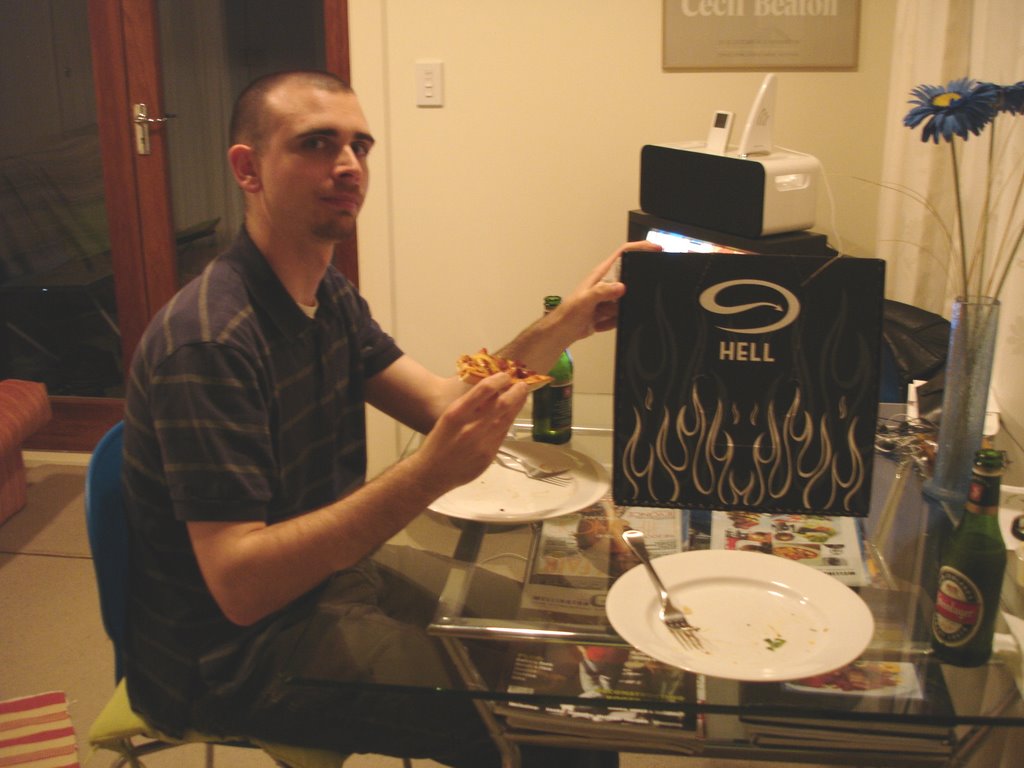 During the day we get down to business, and we reserve the evenings for relaxation. We're even developing a social circle through the Aikido class we're taking three days a week. This has been the best lifestyle choice we've made here so far. This dojo practices the same style of Aikido that I trained in in the Missoula, with the expected stylistic differences of the sensei, of course. My body's felt right at home on the mat so far, and the people we train with are such a friendly and energetic lot that we feel very welcome. I'm quickly understanding the comforts of physical exercise (read: getting thrown around).
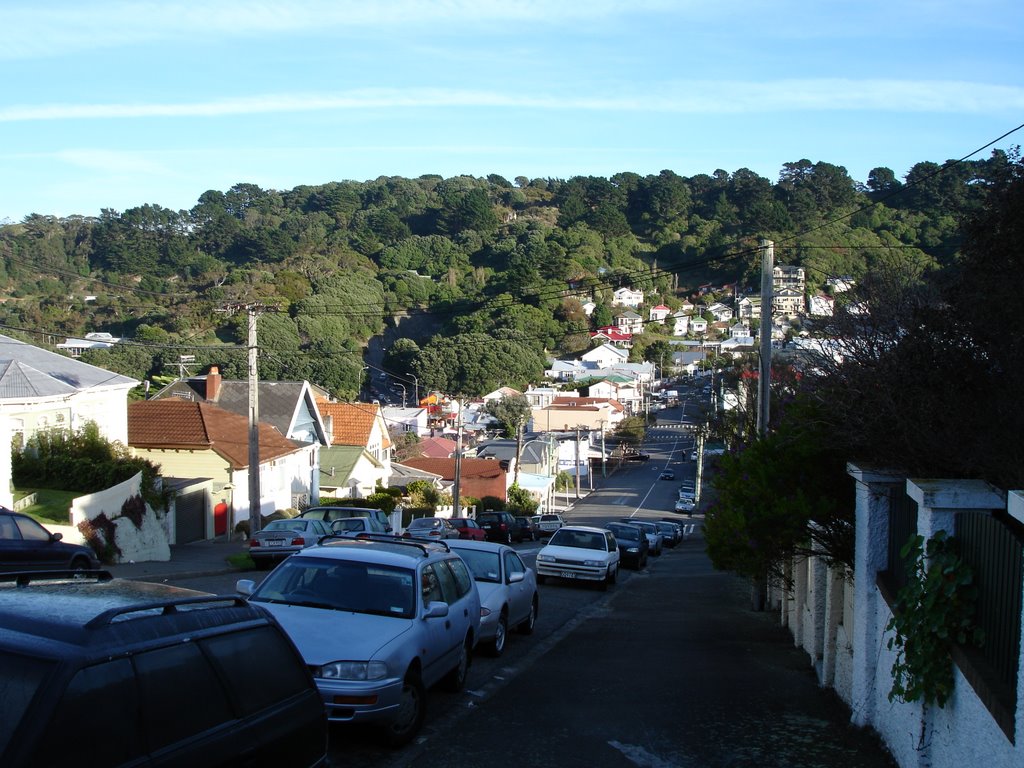 Here's a picture of Hataitai, the neighbourhood we're staying in. We're able to see Evans Bay, a bay in Wellington Harbor, and the waters of the Pacific from just up the street. It's a quiet little area with a great community feel to it. And it's only a 10 minute bus ride into the CBD, which has been very handy since we don't have a car yet.
Wednesday, May 03, 2006
Adventures in Grocery Shopping
We walked into a neighbourhood grocery store, on a quest for a taste of home. Since we're staying in a place with a kitchen, we decided to make ourselves at home in kiwi culture by making one of our favourite dishes from the states: chicken soup with tofu and leeks. We were sure that we'd be able to find all of the necessary ingredients, and we were really craving a taste of home.
The first steps into any grocery inevitably lead you through the produce department. In a foreign country this is roughly like falling through the rabbit hole: things are familiar, but rearranged and slightly off kilter compared to our sense of normal. The colours look a little different, prices are based on kilograms instead of pounds, and foods that would cozily rest side by side in the States now lie a respectable distance from each other. We picked up the obligatory kiwis, much larger than we're used to seeing, along with some fiejoas (these are related to the guava family, but are green, tomato-like in texture, and taste unlike anything I've encountered to date). Far from disgusting, we picked up enough to snack on for the next few days.
Limes, check. Leeks, check. Cilantro...hmmm, it should be with the rest of the herbs. No dice on a cursory glance. We head for the nearest employee.
"Excuse me, but do you sell cilantro?"
The gentleman gives us a confused look. "What? What is that again?"
"Cilantro. An herb, has small flat leaves like parsley, very fresh taste?"
"I've never heard of that. Let's see, maybe this is what you're looking for," as he leads us to the beet greens. Not quite.
As we try again to explain what cilantro looks and tastes like, two different shoppers make their way over to us. Evidently foreigners fumbling through grocery stores is a spectator sport here. They both start offering possible names for this mystery herb, showing us a variety of plants, smelling and peering into our faces to gauge our reactions. One woman sniffs her herbs, mulling over our newest rendition of a description. "Oh, you must mean coriander?" She offers me a sniff of her greenery.
Yes, the scent matches. It looks about right too. I'm tempted to pull off a leaf to chew, but somehow that seems too personal (as though putting my nose into another woman's groceries isn't).
The stock person breathes a sigh of relief. The mystery solved, he can now assuredly lead us to the herb section, deftly recommend the best buy, and go about his business. We grab a package of coriander and head for the next isle. Mystery solved.
Tofu, chicken, broth, a bottle of wine. Kiwi's are crazy about their wine, so we figured we'd start the monumental task of sampling the regional products. Ring it all up...uh oh, carded for the wine. (What do you mean you don't accept a Montana driver's licence as proof of age?) Evidently buying wine is a much more important task than renting a car, or driving legally for that matter. We need our passports to prove that we're old enough. We decide to forgo the wine for the moment and complete the purchase. Groceries in hand, we catch the next bus back to our neighbourhood.
Mum's words about a job well done ringing in my ears, I collect my passport later that evening and head back for that bottle of wine. Ultimately it wasn't very good, but we now know to bring our passports with us when we go to the grocery store. We also know to start thinking of coriander not as simply the spice, but as the plant that produces it. And we try to go to the stores often now: it's nice to cook for ourselves, save some cash, develop a routine and, most of all, taste home.
The first steps into any grocery inevitably lead you through the produce department. In a foreign country this is roughly like falling through the rabbit hole: things are familiar, but rearranged and slightly off kilter compared to our sense of normal. The colours look a little different, prices are based on kilograms instead of pounds, and foods that would cozily rest side by side in the States now lie a respectable distance from each other. We picked up the obligatory kiwis, much larger than we're used to seeing, along with some fiejoas (these are related to the guava family, but are green, tomato-like in texture, and taste unlike anything I've encountered to date). Far from disgusting, we picked up enough to snack on for the next few days.
Limes, check. Leeks, check. Cilantro...hmmm, it should be with the rest of the herbs. No dice on a cursory glance. We head for the nearest employee.
"Excuse me, but do you sell cilantro?"
The gentleman gives us a confused look. "What? What is that again?"
"Cilantro. An herb, has small flat leaves like parsley, very fresh taste?"
"I've never heard of that. Let's see, maybe this is what you're looking for," as he leads us to the beet greens. Not quite.
As we try again to explain what cilantro looks and tastes like, two different shoppers make their way over to us. Evidently foreigners fumbling through grocery stores is a spectator sport here. They both start offering possible names for this mystery herb, showing us a variety of plants, smelling and peering into our faces to gauge our reactions. One woman sniffs her herbs, mulling over our newest rendition of a description. "Oh, you must mean coriander?" She offers me a sniff of her greenery.
Yes, the scent matches. It looks about right too. I'm tempted to pull off a leaf to chew, but somehow that seems too personal (as though putting my nose into another woman's groceries isn't).
The stock person breathes a sigh of relief. The mystery solved, he can now assuredly lead us to the herb section, deftly recommend the best buy, and go about his business. We grab a package of coriander and head for the next isle. Mystery solved.
Tofu, chicken, broth, a bottle of wine. Kiwi's are crazy about their wine, so we figured we'd start the monumental task of sampling the regional products. Ring it all up...uh oh, carded for the wine. (What do you mean you don't accept a Montana driver's licence as proof of age?) Evidently buying wine is a much more important task than renting a car, or driving legally for that matter. We need our passports to prove that we're old enough. We decide to forgo the wine for the moment and complete the purchase. Groceries in hand, we catch the next bus back to our neighbourhood.
Mum's words about a job well done ringing in my ears, I collect my passport later that evening and head back for that bottle of wine. Ultimately it wasn't very good, but we now know to bring our passports with us when we go to the grocery store. We also know to start thinking of coriander not as simply the spice, but as the plant that produces it. And we try to go to the stores often now: it's nice to cook for ourselves, save some cash, develop a routine and, most of all, taste home.
Saturday, April 22, 2006
Back to Tauranga
 After the bustle of Wellington, we wanted to see a bit more of the sunny north island. We decided to go back to Tauranga for a week to see the sights that we missed the last time around, not to mention the every-day life of the city. Tauranga is the fastest growing city in NZ, after all, so there might be job opportunities here and a progressive style of living. Why not stay for a while to get a feel for the place?
 All it all it's been a good layover for us. We had a chance to get caught up on paperwork that we've been putting off up to this point. I applied for a few jobs here, and Peter's been applying for jobs via the internet. We've also had some very fun days on the beaches, another a walk on the mount, checked out a jujitsu dojo, and did some grocery shopping (always fun in another country). We even had our first encounter with The Warehouse, NZs version of WalMart (dun dun DUN!). Not exactly the most exciting week, but well worth it. I think we've seen more of what it's like to live like a kiwi here than on any other other part of our trip.
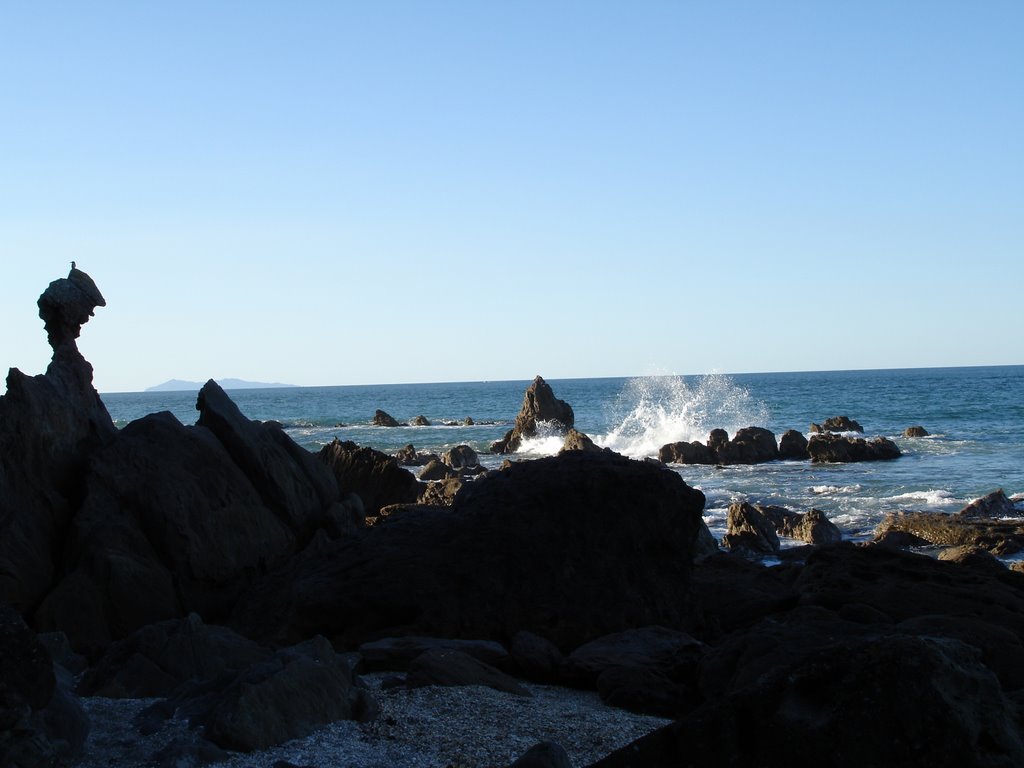 After a week we've come to the conclusion that Tauranga is a bit sleepy for us. It's definitely a nice place to visit, what with the beautiful scenery and all, but it's beginning to feel like there are two Taurangas. There's the tourist spots that are full of cool cafes, surf shops,kiwifruit orchards, and wineries, and then there's the sprawling shopping and residential areas that are nearly impossible to navigate if you don't have a car. It feels a lot like any other tourist town at this point: nice to visit and equally nice to leave be after a while. We're still drawn to Wellington (for some reason we haven't pinned down yet-call it a predisposition?), so we'll fly down there on Monday to start our next wave of job hunting.
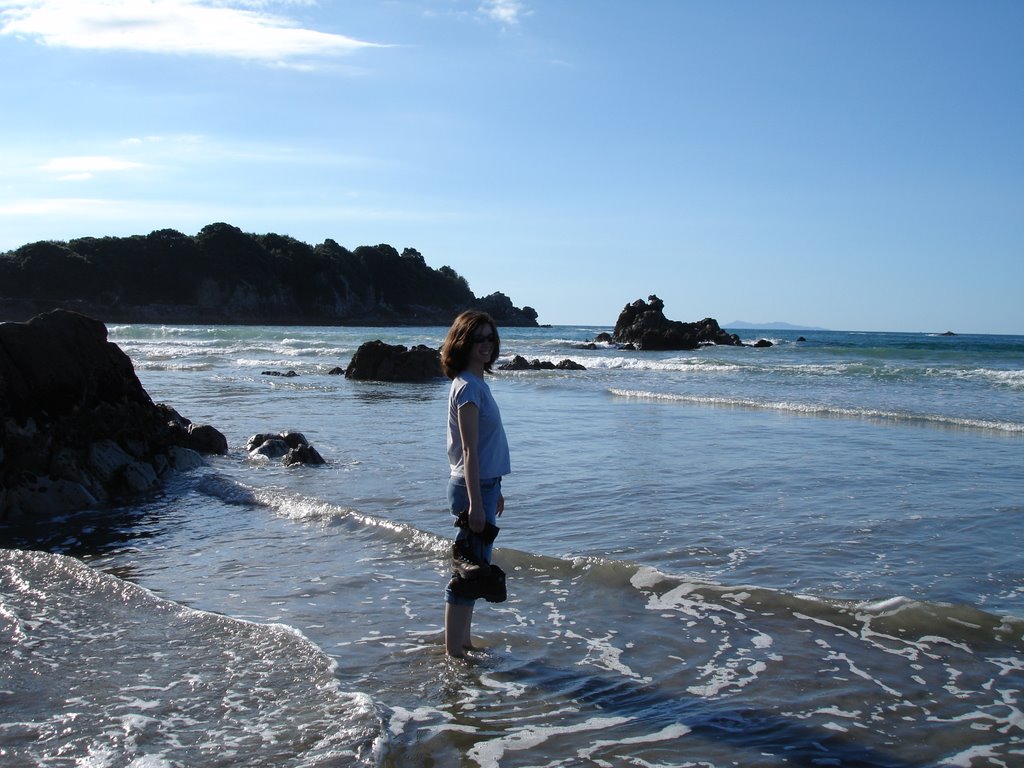 Oh, and this last picture is for Jen. I know you were wanting to see me hugging a tree or some such hippie nonsense, but this was the best we could do for the day. After all, one of us has to be able to dip into the ocean without getting stung by jelly fish.
Subscribe to:
Posts (Atom)
